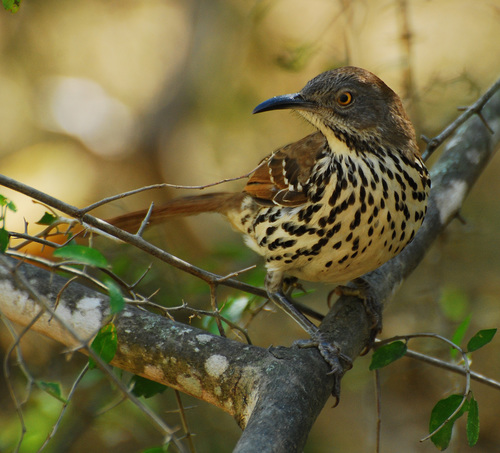
Long-billed Thrasher
Toxostoma longirostre
A resident of the sun-drenched thorny scrub, the Long-billed Thrasher is a charismatic songster with a piercing gaze. Known for its 'thrashing' foraging style and its preference for the deep shadows of garden hedges, it is a prized sighting for any backyard observer.
Quick Identification
Size
Length: 10.5–12 in (26.5–30.5 cm); Wingspan: 12.5–14 in (32–36 cm); Weight: 2.3–3.1 oz (65–89 g)
Colors
Dull rufous-brown upperparts, white underparts with heavy black streaking, gray face and cheeks, and striking orange-yellow eyes. Both sexes look identical.
Key Features
- Long, dark, slightly decurved bill
- Heavy black (not brown) teardrop streaking on a white chest
- Gray face that contrasts with a reddish-brown crown
- Vivid orange or yellow eyes
- Long, rounded tail often held slightly upward
When You’ll See Them
Geographic range
Where Does the Long-billed Thrasher Live?
The Long-billed Thrasher is a North American specialist, primarily found in the subtropical lowlands of the Rio Grande Valley in South Texas. Its range extends southward through eastern Mexico, following the coastal slope down into the state of Veracruz. Within this relatively narrow geographic corridor, it remains a permanent resident, rarely wandering far from its home territory.
Basemap © OpenStreetMap contributors
Behavior
The Long-billed Thrasher is a shy, master of the undergrowth, preferring the safety of dense thorny thickets and tangled brush. Unlike many birds that sing from the highest canopy, this thrasher often stays hidden while belt out a complex, mimicking song that includes whistles, chirps, and repeated phrases. While they are secretive, they are also highly territorial, and you may see them aggressively defending their nesting site from other birds.
In the backyard, they are primarily ground-foragers. They spend much of their time "thrashing" through fallen leaves and mulch, using their long, sturdy bills to toss debris aside in search of hidden insects. While they may visit feeders for suet or fruit, they are far more likely to be seen hopping along the edge of a garden bed or under a hedge where the cover is thick.
EverydayEarth exclusive
Camera Tips
To capture the Long-billed Thrasher on your AI camera, the most critical factor is placement height. These birds are ground-dwellers by nature; mounting your camera just 12 to 18 inches off the ground, angled slightly downward toward a patch of leaf litter or mulch, is significantly more effective than a high fence mount. Aim the lens at the dark, "edge" zones of your yard—where a hedge meets the lawn or under a dense shrub.
Because they are shy, they are hesitant to cross wide-open spaces. If you use a bird feeder, place your camera near a low-profile tray feeder or a suet cage tucked inside a bush rather than on a pole in the middle of the yard. They are particularly fond of water, especially in their hot South Texas and Mexican range. A ground-level bird bath or a small dripping water feature is an irresistible lure for a thrasher looking to bathe or drink in safety.
Set your camera to its highest motion sensitivity, as these birds move with quick, jerky hops and can easily be missed by slower triggers. Since they are most active in the early morning when light is low, ensure your camera has good low-light performance or "golden hour" optimization. In the spring and early summer, listen for their mimics; if you hear a bird that sounds like several different species in a row, they are nearby and likely to pass your camera's field of view soon.
Similar Species
Species that look similar or are commonly confused with Long-billed Thrasher.
Frequently Asked Questions
Record Long-billed Thrasher at your habitat
Connect a camera to start building your own species record — AI identifies every visitor automatically.