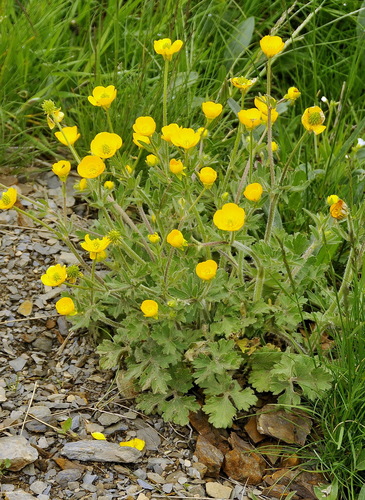
bulbous buttercup
Ranunculus bulbosus
A golden herald of spring, the bulbous buttercup lights up meadows with its waxy, sun-tracking blooms and unique downward-pointing sepals.
Quick Identification
Size
Height ranges from 15 to 40 cm (6 to 16 inches); flowers are 2 to 3 cm (0.8 to 1.2 inches) wide
Colors
Brilliant, glossy yellow petals; light green sepals that turn downward; dark green, often mottled foliage
Key Features
- Swollen bulb-like base (corm) at the soil line
- Reflexed sepals that fold back toward the stem
- Deeply divided three-lobed leaves with a stalked central lobe
- Shiny, waxy petals that create a mirror-like reflection
When You’ll See Them
Geographic range
Where Does the bulbous buttercup Live?
Native to Europe, North Africa, and Western Asia, the bulbous buttercup is a highly successful traveler. It was introduced to North America centuries ago and has since naturalized across much of the United States and southern Canada. You will most commonly find it in the eastern and northwestern regions of the continent, where it thrives in coastal grasslands and inland agricultural fields alike.
Basemap © OpenStreetMap contributors
Behavior
The bulbous buttercup is one of the earliest spring wildflowers to emerge, often appearing in lawns and meadows as early as April. Unlike its relatives that spread through creeping runners, this species relies on its namesake bulbous corm to store energy. This allow it to survive periods of drought or intense summer heat by going dormant. The flowers are heliotropic, meaning they move slightly throughout the day to track the sun, maximizing the warmth inside the flower cup to attract pollinators.
A fascinating aspect of its biology is its chemical defense system. When the plant is crushed or bitten, it releases ranunculin, a compound that turns into a bitter, blistering oil called protoanemonin. This makes the plant unpalatable to most livestock and deer, though small insects and specialized pollinators have evolved to manage these toxins while feeding on its nectar.
EverydayEarth exclusive
Camera Tips
Capturing the bulbous buttercup requires a low-angle approach. To highlight its most defining characteristic—the downward-folded sepals—position your camera on a ground stake or a small tripod just 5 to 8 inches above the soil. Aim the lens slightly upward at a 45-degree angle toward the underside of the flower head. This perspective also captures the 'bulb' at the base of the stem if you clear away a bit of surface leaf litter.
Because the petals are extremely glossy, they act like tiny parabolic mirrors. In direct midday sun, this causes heavy lens flare or 'blown-out' white spots in your photos. For the best results, set your camera to trigger during the golden hour—shortly after sunrise or just before sunset—when the softer light brings out the deep saturation of the yellow without the harsh glare. If your camera has a macro mode, use it to capture the intricate details of the center of the bloom.
To document the life of the plant, use a timelapse setting with one photo every 15 to 30 minutes. This is especially rewarding for bulbous buttercups as you can watch the flowers physically follow the sun across the sky and then close up tightly as evening falls. Make sure to trim any long blades of grass within 12 inches of the lens, as even a light breeze will cause them to move and trigger the motion sensor repeatedly, draining your battery.
Similar Species
Species that look similar or are commonly confused with bulbous buttercup.
Frequently Asked Questions
Record bulbous buttercup at your habitat
Connect a camera to start building your own species record — AI identifies every visitor automatically.