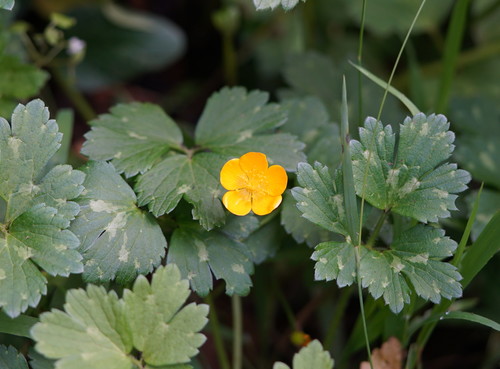
Creeping buttercup
Ranunculus repens
A shimmering carpet of gold in damp garden corners, the creeping buttercup is a master of the low-ground, using 'walking' stems to colonize your backyard.
Quick Identification
Size
Height 15-60 cm (6-24 inches); creeping stolons can spread over 1 metre (3.3 feet) in length.
Colors
Brilliant, glossy yellow petals; dark green foliage often with pale, silvery-white watermarks or blotches.
Key Features
- Five glossy yellow petals with a waxy sheen
- Creeping stolons (runners) that root at the nodes
- Three-lobed compound leaves with a stalked central leaflet
- Hairy stems and leaf undersides
When You’ll See Them
Geographic range
Where Does the Creeping buttercup Live?
Originally native to the temperate regions of Europe, Asia, and Northwest Africa, the creeping buttercup has become one of the most successful globetrotting plants. It is now widely naturalized throughout North America, appearing in nearly every state and province from Alaska to the southern United States. It has also established a strong presence in the temperate zones of South America, Australia, and New Zealand, particularly in areas with high rainfall or heavy irrigation.
Basemap © OpenStreetMap contributors
Behavior
The creeping buttercup is a resilient and opportunistic perennial known for its aggressive growth habit. While it produces seeds, its primary method of colonizing a backyard is through its horizontal stems, or stolons. These runners 'walk' across the soil, sending down new roots at every node to create a dense, interconnected mat that can quickly outcompete grasses and other garden plants.
This species is highly adapted to disturbed and compacted soils, often thriving in areas where other plants struggle. It has a unique defense mechanism: the plant contains protoanemonin, a bitter, acrid oil that causes mouth blisters in livestock. This makes it naturally resistant to many grazing animals, though it is a favorite landing pad for a variety of small pollinating insects.
EverydayEarth exclusive
Camera Tips
To capture the creeping buttercup effectively, you should treat it as a stage for insect activity rather than a moving subject. Place your camera on a low-profile ground mount or a short tripod, aiming the lens about 15 to 30 centimetres (6 to 12 inches) above the ground. Angle the camera slightly downward to showcase the star-like shape of the flowers and the distinctive three-lobed leaves.
The glossy petals of the buttercup have a unique cell structure that reflects light intensely, which can cause 'lens flare' or overexposed white spots in bright midday sun. For the most vibrant yellow tones, set your camera to capture images during the 'blue hour' just before sunrise or during late afternoon when the light is softer. If your AI camera allows for time-lapse, this is the best way to record the flowers as they open in response to morning light and close during heavy rain.
Because this plant thrives in moist soil, you can 'lure' more action to the site by lightly misting the patch with water in the early morning; this often attracts thirsty pollinators and creates beautiful dew-drop effects for your photos. Ensure you clear away any long blades of grass that might sway in the wind directly in front of the lens, as these will trigger false motion alerts and obscure the delicate blooms.
In the spring and early summer, keep your camera settings on high-speed trigger mode if possible. Creeping buttercups are major hubs for hoverflies, solitary bees, and small beetles. By focusing on a healthy cluster of flowers, you are likely to capture a surprising amount of backyard biodiversity that occurs just inches above the soil line.
Similar Species
Species that look similar or are commonly confused with Creeping buttercup.
Meadow Buttercup
Grows much taller (up to 90cm) and lacks the creeping runners that root at nodes.
Bulbous Buttercup
Has a distinct swollen, bulb-like base and sepals that fold backwards (reflexed) away from the petals.
Lesser Celandine
Flowers have 8-12 petals rather than 5, and leaves are heart-shaped rather than three-lobed.
Frequently Asked Questions
Record Creeping buttercup at your habitat
Connect a camera to start building your own species record — AI identifies every visitor automatically.