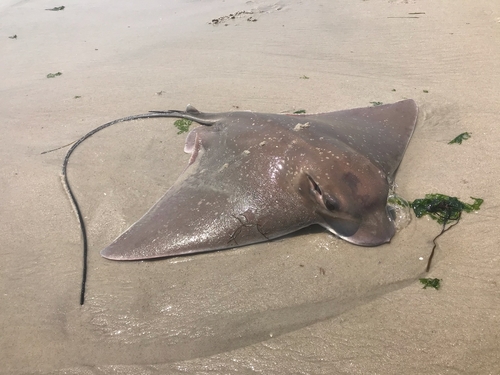
Bullnose Eagle Ray
Myliobatis freminvillei
Witness the elegant 'flight' of the Bullnose Eagle Ray, a coastal master known for its unique rounded snout and impressive aerial leaps. This Atlantic native is a stunning find for any underwater camera enthusiast.
Quick Identification
Size
Disc width up to 106 cm (42 in); weight typically ranges from 10 to 20 kg (22–44 lbs)
Colors
Dorsal surface is uniform grayish, reddish-brown, or chocolate brown; ventral side is white or pale yellowish; no spotting or intricate patterns
Key Features
- Distinctive rounded, bull-like snout
- Whip-like tail significantly longer than body width
- Single venomous spine located near the base of the tail
- Pectoral fins join at the head to form a subrostral lobe
When You’ll See Them
Geographic range
Where Does the Bullnose Eagle Ray Live?
Native to the western Atlantic Ocean, the Bullnose Eagle Ray lives in two distinct geographic bands along the coastlines of North and South America. The northern population is found from Massachusetts down to Texas and the Gulf of Mexico, while the southern population ranges from Venezuela to the coast of Buenos Aires, Argentina. Notably, this species is largely absent from the Caribbean islands and the Central American coastline, creating a unique split in its distribution.
Basemap © OpenStreetMap contributors
Behavior
The Bullnose Eagle Ray is a highly active and graceful swimmer, often observed 'flying' through the water column using synchronized beats of its powerful pectoral fins. Unlike many stingrays that remain camouflaged on the sea floor, this species is frequently found swimming near the surface or in mid-water. They are generally solitary but are known to congregate in small groups during seasonal migrations or in areas with an abundance of food.
These rays exhibit a curious yet shy temperament. One of their most spectacular behaviors is 'breaching,' where they leap entirely out of the water. While the exact reason for this is debated, it is likely used to escape predators like larger sharks, dislodge skin parasites, or communicate with other rays. Although they possess a venomous tail spine, they are not aggressive and only use it as a last resort for self-defense if stepped on or cornered.
EverydayEarth exclusive
Camera Tips
To successfully capture a Bullnose Eagle Ray on camera, you must use a specialized underwater setup or a high-quality trail camera protected by a saltwater-rated waterproof housing. For coastal residents with private docks or waterfront access, the best results come from mounting the camera 1 to 2 meters below the surface, aimed toward sandy clearings or near oyster bars. These rays are 'suction feeders' that root through the substrate, so focusing your lens on areas where the seafloor meets a structure often yields the best footage.
Tidal cycles are the most critical factor for timing your shots. Bullnose Eagle Rays often move into shallow estuaries and bays on the rising tide to access new feeding grounds. Set your camera to record in high-definition video or use a burst photo mode with a fast shutter speed (at least 1/500s) to freeze the motion of their undulating 'wings.' Natural sunlight provides the best color accuracy for their reddish-brown skin, so early morning or late afternoon shots are ideal when the sun penetrates the water at an angle.
Because saltwater environments are harsh, ensure your camera housing is rinsed with fresh water after every retrieval and check the seals for sand or salt crystals. If you are monitoring at night, use infrared (IR) illumination rather than white light, as bright flashes can startle the rays and cause them to flee the area. While you shouldn't use artificial bait, placing your camera near natural shellfish beds or using a weighted tripod to keep the camera steady against tidal currents will significantly improve your chances of a clear sighting.
Similar Species
Species that look similar or are commonly confused with Bullnose Eagle Ray.
Southern Eagle Ray
Smaller in size with a less rounded snout; the two are very difficult to distinguish without close inspection of dental plates.
Spotted Eagle Ray
Easily distinguished by a dark back covered in numerous white spots and a much longer, more pointed snout.
Cownose Ray
Features a distinctively indented, 'm-shaped' forehead and is usually lighter in color (brownish-gold).
Frequently Asked Questions
Record Bullnose Eagle Ray at your habitat
Connect a camera to start building your own species record — AI identifies every visitor automatically.