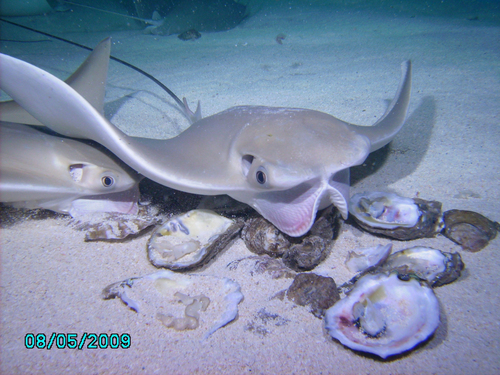
Cownose Ray
Rhinoptera bonasus
Witness the underwater 'flight' of the Cownose Ray, a graceful social traveler known for its unique cow-like snout and spectacular mass migrations along the Atlantic coast.
Quick Identification
Size
Wingspan typically 24–36 inches (60–90 cm); can weigh 25–50 lbs (11–23 kg)
Colors
Olive-brown to dark gray upper body with a white or pale yellowish underside; no distinct spots or patterns
Key Features
- Distinctive double-lobed snout with a central indentation
- Diamond-shaped pectoral fins with pointed tips
- Long, whip-like tail with a venomous spine at the base
- High-set eyes on the sides of a thick head
When You’ll See Them
Geographic range
Where Does the Cownose Ray Live?
The Cownose Ray is a signature species of the Western Atlantic Ocean, claiming a massive territory that stretches from the temperate waters of Southern New England down to the tropical shores of Southern Brazil. While they are frequent visitors to the United States Atlantic coast and the Gulf of Mexico, they are also native to the Caribbean islands and the eastern coast of Central America. These migratory wanderers are commonly found in the nutrient-rich estuaries of the Chesapeake Bay during the summer before embarking on long-distance journeys to warmer southern climates for the winter.
Basemap © OpenStreetMap contributors
Behavior
Cownose Rays are famous for their highly social nature, often traveling in massive schools that can number in the thousands. This schooling behavior is most spectacular during their seasonal migrations, where they appear like a synchronized golden-brown carpet moving just beneath the water's surface. Unlike many other rays that spend most of their time buried in the sand, Cownose Rays are active swimmers that spend a significant amount of time in the water column.
While they possess a venomous barb for defense, they are notoriously shy and generally non-aggressive toward humans, preferring to flee rather than confront. In coastal communities, they are often seen near piers and shorelines, where they use their powerful pectoral fins to 'flap' against the sea floor. This action stirs up sediment to reveal hidden prey, a behavior that is both a vital ecological role and a fascinating sight for backyard observers with waterfront access.
EverydayEarth exclusive
Camera Tips
Capturing the Cownose Ray on camera requires a specialized approach since they are entirely aquatic. If you have a backyard dock or bulkhead, the most effective setup is a pole-mounted underwater camera or a submersible housing secured to a pier piling. Position the camera about 2 to 4 feet below the low-tide line, angled slightly downward toward the sandy bottom. Because these rays are attracted to the vibrations and scents of shellfish, placing your camera near an active oyster reef or a sandy flat where clams are present will significantly increase your sighting frequency.
Visibility is the biggest challenge for AI detection underwater. To get the best results, set your camera to trigger during the hours of peak sunlight (10 AM to 2 PM) when light penetration is highest. If the water is murky, use a camera with high-contrast settings to help the AI distinguish the ray's dark silhouette against the seabed. Avoid using bright artificial lights at night, as the backscatter from suspended particles often confuses motion sensors; instead, rely on ambient light or high-sensitivity sensors.
For those without permanent underwater mounts, a 'drop-cam' weighted with a small anchor can be effective. Try 'chumming' the area by placing crushed crabs or clams inside a perforated PVC pipe or mesh bag tethered within the camera's field of view. This will encourage the rays to stay in frame longer as they use their snouts to investigate the scent. Set your camera to a high frame rate (at least 60fps) to capture the fluid, bird-like flapping of their wings, which is one of their most identifiable characteristics.
Similar Species
Species that look similar or are commonly confused with Cownose Ray.
Frequently Asked Questions
Record Cownose Ray at your habitat
Connect a camera to start building your own species record — AI identifies every visitor automatically.