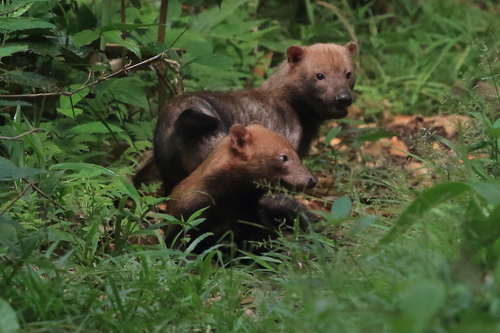
Bush Dog
Speothos venaticus
The Bush Dog is a rare, semi-aquatic canine that hunts in family packs deep within the South American rainforest. With its otter-like face and webbed feet, this elusive 'ghost of the jungle' is a prize find for any wildlife enthusiast.
Quick Identification
Size
Length: 55-75 cm (22-30 in); Weight: 5-8 kg (11-18 lb)
Colors
Tawny or reddish-brown fur on the head and neck, darkening to a deep brown or black on the hindquarters and tail; often features a lighter patch on the throat.
Key Features
- Extremely short legs and a stocky, low-slung body
- Small, rounded ears and a blunt, otter-like face
- Webbed feet for swimming
- Short, bushy tail usually dark in color
When You’ll See Them
Geographic range
Where Does the Bush Dog Live?
Native to the Neotropical region of Central and South America, the Bush Dog has an expansive but patchy distribution. Its range begins in Panama and stretches through Colombia and Venezuela, extending south across the Amazon basin into Peru, Bolivia, and Brazil, finally reaching its southernmost limits in northern Argentina and Paraguay. Despite this massive territory, they are considered rare throughout most of their range, with the most stable populations currently found in the undisturbed wilderness areas of Suriname, Guyana, and the Peruvian Amazon.
Basemap © OpenStreetMap contributors
Behavior
The Bush Dog is one of the most social and unique canines in the world, living and hunting in tight-knit family packs of up to 12 individuals. Unlike most dogs, they are semi-aquatic and possess partially webbed feet, making them excellent swimmers. They are known for their high-pitched vocalizations, which sound more like bird chirps or whines than typical barking, used to maintain contact while moving through dense undergrowth.
These animals are primarily diurnal, meaning they are active during the daylight hours, though they are rarely seen by humans due to their shy nature and preference for thick cover. Within the pack, there is a clear hierarchy, and they often hunt cooperatively to take down prey much larger than themselves. They are elusive and generally avoid human settlements, making them a 'holy grail' species for wildlife photographers and researchers.
EverydayEarth exclusive
Camera Tips
Capturing a Bush Dog on camera requires patience and strategic placement, as these animals are notoriously shy. Because they are low-slung animals with short legs, you must mount your camera much lower than you would for a deer or a jaguar. Position the lens about 20-30 centimeters (8-12 inches) off the ground. If the camera is too high, you may only capture the top of their backs or miss them entirely in thick vegetation.
Focus your efforts on wildlife corridors near water. Bush Dogs are semi-aquatic and frequently travel along riverbanks, small streams, or through seasonally flooded forests. Look for 'choke points' where the vegetation thins out near a water source. Because they travel in packs, set your camera to take bursts of 3-5 photos or record short video clips (15-30 seconds). If you only take a single photo, you might capture the lead dog but miss the rest of the family group following behind.
While they are primarily diurnal, they are most active in the early morning and late afternoon. Use high-speed SD cards to ensure the camera resets quickly between triggers. Avoid using white flash if possible; although they aren't as strictly nocturnal as other predators, a bright flash can spook a pack and prevent them from returning to that trail. Scent lures like fatty acid tablets or even small amounts of meat-based bait can work, but check local regulations first, as these can sometimes attract unwanted attention from larger predators like jaguars.
Similar Species
Species that look similar or are commonly confused with Bush Dog.
Jaguarundi
A feline with a much longer tail, more pointed ears, and a more slender body profile.
Crab-eating Fox
Has much longer legs, a typical fox-like pointed muzzle, and larger, upright ears.
Tayra
A member of the weasel family with a much longer, fluffier tail and a distinct yellow or white patch on the chest.
Frequently Asked Questions
Record Bush Dog at your habitat
Connect a camera to start building your own species record — AI identifies every visitor automatically.