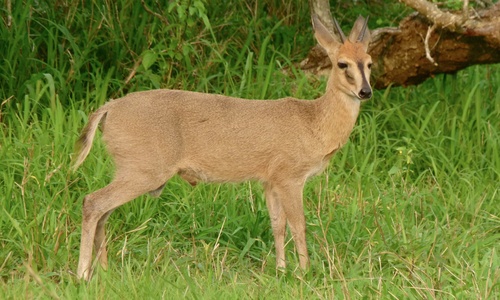
Bush Duiker
Sylvicapra grimmia
The Bush Duiker is a master of disguise, a tiny and resilient antelope that thrives right under our noses in the African scrub. With its signature facial stripe and cautious 'diving' habit, it is one of the most rewarding species to discover on a backyard trail camera.
Quick Identification
Size
Height: 45–60 cm (18–24 in) at shoulder; Weight: 12–25 kg (26–55 lbs)
Colors
Grizzled gray to reddish-brown coat with white underparts; distinctive black stripe on the face; males have small, straight horns.
Key Features
- Prominent vertical black stripe from the nose to the forehead
- Distinctive tuft of long hair between the ears
- Small, straight horns on males that point backward
- Arched back with hindquarters slightly higher than shoulders
When You’ll See Them
Sightings on EverydayEarth
Aug 2, 2026
A small bush duiker is seen foraging along the sloping riverbank, picking its way through the dry vegetation and rocks. It moves cautiously across the sun-dappled ground near the water's edge, occasionally pausing to sniff for food among the fallen branches.
Aug 2, 2026
A Bush Duiker navigates the rocky, dry terrain along the riverbank. It spends most of the time sniffing the ground and foraging among the rocks and sparse vegetation, moving with the cautious, jerky steps typical of the species.
Aug 2, 2026
A Bush Duiker enters the frame from the bottom, foraging along the dry, rocky riverbank. It moves with a characteristic cautious gait, sniffing the ground and pausing to scan its surroundings before heading up the slope toward the trees.
Jul 26, 2026
A small Bush Duiker is seen foraging on the rocky, sunlit slope on the left side of the frame. It moves cautiously through the dry brush, sniffing the ground for food before pausing to look around.
Jul 26, 2026
A male Bush Duiker stands alert on the rocky, sun-drenched bank of the river. It remains mostly stationary, occasionally turning its head to survey the surrounding woodland and the water's edge.
Jul 25, 2026
Two Bush Duikers are seen foraging on the steep, sandy bank of the river. They move slowly across the slope, sniffing the ground and grazing on sparse vegetation under the bright morning sun.
Geographic range
Where Does the Bush Duiker Live?
The Bush Duiker is native to the vast landscapes of Sub-Saharan Africa, boasting one of the widest distributions of any African antelope. Its core range spans from the southern tip of South Africa northward through East Africa and across the Sahel to Senegal, though it intentionally avoids the dense, humid rainforests of the Congo Basin and the hyper-arid deserts of the Horn of Africa. Because they are highly adaptable to fragmented habitats, they are frequently spotted in peri-urban areas and agricultural zones across countries like South Africa, Zimbabwe, Kenya, and Nigeria.
Basemap © OpenStreetMap contributors
Behavior
Bush Duikers are primarily solitary and highly territorial animals. They spend much of their day resting in dense vegetation to avoid predators, emerging during the cooler hours of the early morning and late evening to forage. The name 'Duiker' comes from the Afrikaans word for 'diver,' referring to their habit of diving into thick brush at the slightest hint of danger. Unlike many other antelopes, they do not form herds, though a mating pair may occasionally be seen together for short periods.
These small antelopes are remarkably adaptable and have managed to survive in close proximity to humans. They are known to inhabit the fringes of suburban gardens and agricultural land, provided there is enough cover for them to hide. They mark their territories using scent glands located in dark slits beneath their eyes, often rubbing these against twigs and branches. Despite their small size, they are incredibly hardy and can survive in environments ranging from semi-desert to high-altitude moorlands.
EverydayEarth exclusive
Camera Tips
To successfully capture a Bush Duiker on camera, placement is everything. These small antelopes are creatures of habit and often use the same 'runways' or paths through dense vegetation. Look for small, narrow trails near the edges of thickets or garden boundaries. Position your camera low to the ground—about 30 to 45 centimeters (12-18 inches) high—to match their eye level. Angle the camera slightly upward if the terrain is sloped, ensuring you capture the facial markings and the distinctive tuft of hair on their head.
Because they are extremely skittish, use a camera with a 'No Glow' or 'Invisible' infrared flash to avoid startling them at night. Bush Duikers are highly sensitive to white light or red-glow LEDs, which might cause them to avoid the area in the future. Set your trigger speed to the fastest possible setting; they move quickly and often 'dive' into cover before a slow camera can fire. A burst mode of 3-5 photos or a short 10-second video clip is ideal for observing their cautious behavior and scent-marking rituals.
While you shouldn't necessarily 'bait' wildlife in a way that creates dependency, Bush Duikers are highly attracted to fallen fruit. If you have a fruiting tree like a wild plum or even a garden fruit tree, placing the camera nearby during the ripening season is a surefire strategy. They are also frequent visitors to bird baths or low-lying water features during the dry season. Early morning and late evening are the 'golden hours' for sightings, so ensure your camera is active during these periods.
Similar Species
Species that look similar or are commonly confused with Bush Duiker.
Frequently Asked Questions
Record Bush Duiker at your habitat
Connect a camera to start building your own species record — AI identifies every visitor automatically.