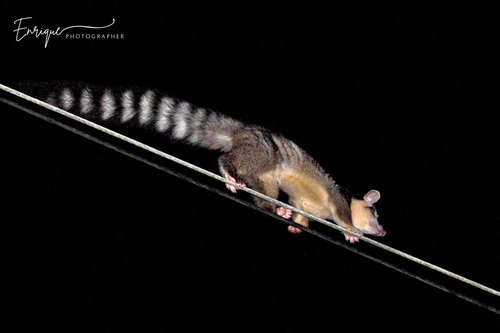
Cacomistle
Bassariscus sumichrasti
A master of the tropical canopy, the Cacomistle is a ring-tailed acrobat that haunts the high jungles of Central America. Rarely seen by human eyes, this nocturnal relative of the raccoon is a true ghost of the cloud forest.
Quick Identification
Size
Head-body length of 38-47 cm (15-18.5 in) with a tail of 39-53 cm (15-21 in); weighs between 0.8-1.5 kg (1.8-3.3 lbs)
Colors
Buff-brown to grayish-brown upperparts with pale cream or white underparts; tail has 8-10 prominent black and white rings
Key Features
- Extraordinarily long, bushy tail with distinct black and white rings
- Large, pointed ears and oversized dark eyes with pale rings
- Slender, fox-like face and lithe, agile body
When You’ll See Them
Geographic range
Where Does the Cacomistle Live?
This elusive climber is native to the tropical regions of Central America. Its core range extends from southern Mexico through Guatemala, Belize, Honduras, and Costa Rica, reaching as far south as western Panama. It is a specialist of high-humidity environments, favoring the dense cover of lowland jungles and the misty elevations of highland cloud forests.
Basemap © OpenStreetMap contributors
Behavior
The Cacomistle is a phantom of the high canopy, a strictly arboreal mammal that rarely, if ever, descends to the forest floor. These nimble climbers are almost entirely nocturnal, spending their daylight hours curled up in hollow tree trunks or dense bromeliads. They possess an incredible sense of balance and can rotate their hind ankles 180 degrees, allowing them to descend tree trunks head-first with the grace of a squirrel.
While largely solitary, Cacomistles are vocal animals, using a range of barks, whistles, and chattering sounds to communicate with others or defend their territory. Unlike their more social cousins, the coatis, they prefer a life of quiet seclusion. They are territorial and maintain home ranges that they mark with scent, though they are generally shy and will vanish into the foliage at the first sign of a predator or human presence.
EverydayEarth exclusive
Camera Tips
To capture the Cacomistle on an AI-powered camera, you must look up. Ground-level placements are almost guaranteed to fail because this species is strictly arboreal. Identify a 'canopy highway'—a horizontal branch or a bridge of vines that connects two large trees. Mount your camera 10 to 20 feet high on a trunk, facing along the length of a branch where the animal is likely to walk. Ensure the camera is securely strapped to prevent it from shaking in the wind, which is common in high-canopy environments.
Because they are nocturnal, a camera with a high-quality, 'no-glow' infrared flash is essential. Standard white flashes may startle these shy mammals, causing them to abandon that part of their range. Set your trigger speed to the fastest possible setting (0.2 seconds or less); Cacomistles are incredibly quick and can leap between branches in the blink of an eye. If your camera supports it, use video mode to capture their fluid, feline-like movements.
In backyard settings near forest edges, you can tempt them into view using sweet scents. They are particularly fond of native tropical fruits like figs or bananas. Placing a small amount of fruit on an elevated platform or within a mesh feeder visible to the camera can encourage them to linger. However, avoid over-feeding to ensure they maintain their natural foraging habits. Check your camera's batteries frequently, as the high-trigger frequency of a busy tropical canopy can drain them quickly.
Similar Species
Species that look similar or are commonly confused with Cacomistle.
Frequently Asked Questions
Record Cacomistle at your habitat
Connect a camera to start building your own species record — AI identifies every visitor automatically.