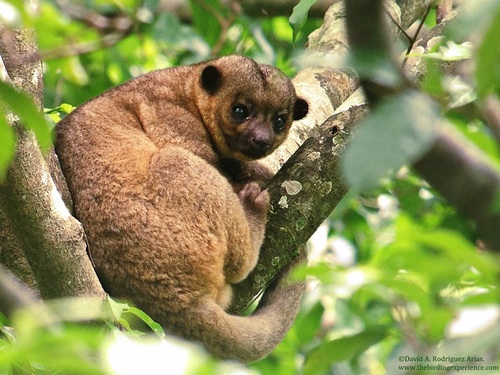
Kinkajou
Potos flavus
The Kinkajou is the golden gymnast of the midnight canopy. With a prehensile tail and a specialized 'honey tongue,' this elusive relative of the raccoon is a master of the tropical treetops.
Quick Identification
Size
Body length 40–60 cm (16–24 in), tail 40–55 cm (16–22 in); weight 1.4–4.6 kg (3–10 lbs)
Colors
Uniform golden-brown or honey-colored dense fur, slightly paler underside, large dark reflective eyes
Key Features
- Fully prehensile tail used for grasping
- Extremely long 5-inch tongue for nectar
- Large forward-facing eyes with a bright eyeshine
- Short, velvet-like fur and small rounded ears
When You’ll See Them
Geographic range
Where Does the Kinkajou Live?
Native to the lush tropical regions of Central and South America, the kinkajou’s range begins in the southern forests of Mexico and stretches down through the Amazon Basin. These golden-furred mammals are found across most of Central America and occupy the northern half of South America, reaching as far south as the Mato Grosso region of Brazil and parts of Bolivia. Because they rely on dense canopy cover, their presence is a hallmark of healthy, connected forest systems throughout the Neotropics.
Basemap © OpenStreetMap contributors
Behavior
Kinkajous are the ultimate nocturnal acrobats of the tropical canopy. Unlike many of their raccoon relatives, they are almost exclusively arboreal, spending nearly their entire lives in the treetops. They use their strong prehensile tails as a fifth limb, often hanging completely upside down to reach ripe fruit or steadying themselves while leaping between branches. Despite their classification in the order Carnivora, they are gentle-natured frugivores that play a critical role as seed dispersers and pollinators.
Socially, kinkajous are more complex than they appear. They often sleep in communal dens inside hollow trees during the day but forage solo or in small family groups at night. A typical group consists of two males, a female, and their offspring, who engage in mutual grooming to reinforce social bonds. They are highly vocal creatures, using a range of barks, chirps, and shrill screams that can be heard echoing through the forest after dark.
EverydayEarth exclusive
Camera Tips
To capture a kinkajou on camera, you must look up. These animals rarely descend to the forest floor, so a standard ground-level trail camera setup will almost certainly miss them. Mount your camera 10 to 20 feet high in the canopy, focusing on horizontal 'travel branches' or 'bridges' that connect large fruiting trees. If you can identify a wild fig tree or a flowering balsa tree, you have found a prime location for a camera trap.
Since kinkajous are strictly nocturnal, your camera’s infrared (IR) capabilities are paramount. Use 'No-Glow' or 'Black' IR flashes to avoid startling the animal, as they have incredibly sensitive eyes. Set your device to record short video clips (15–20 seconds) rather than still photos; the fluid way they use their prehensile tail is best captured in motion and helps distinguish them from other nocturnal mammals like olingos or opossums.
If you are lucky enough to live in a suburban area within their range, you can entice them to a specific branch using a 'lure' of overripe bananas or a small dish of sugar water. Smearing a bit of honey on the bark directly in front of the lens will often cause them to stop and use their remarkable 5-inch tongue, providing an incredible close-up shot that showcases their unique physiology. Ensure the camera is angled slightly downward along the branch to capture their full body and tail.
Similar Species
Species that look similar or are commonly confused with Kinkajou.
Frequently Asked Questions
Record Kinkajou at your habitat
Connect a camera to start building your own species record — AI identifies every visitor automatically.