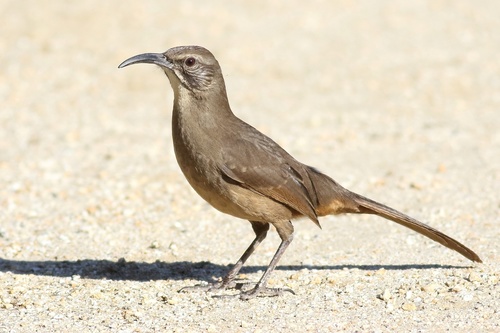
California Thrasher
Toxostoma redivivum
A shy virtuoso of the chaparral, the California Thrasher is famous for its scythe-like bill and incredible talent for vocal mimicry. This ground-dwelling specialist is the ultimate prize for backyard observers in the Golden State.
Quick Identification
Size
Length: 28–32 cm (11–13 in); Wingspan: 30–33 cm (12–13 in); Weight: 80–110 g (2.8–3.9 oz)
Colors
Dull grayish-brown upperparts, pale buff chest, and distinct cinnamon-rufous undertail. Features a dark cheek and a faint pale eyebrow.
Key Features
- Dramatically long, downward-curved black bill
- Rich cinnamon-colored feathers under the base of the tail
- Long, rounded tail often held at an upward angle
- Pale eye-stripe (supercilium) contrasting with a dark face
When You’ll See Them
Geographic range
Where Does the California Thrasher Live?
This bird is a iconic specialist of the Pacific coast of North America. Its native range is almost exclusively tied to the Mediterranean climate zones of California, stretching from the northern Sacramento Valley and coastal ranges down through the foothills and into the Baja California peninsula of Mexico. It is rarely found far from the dense, tangled scrub it calls home, making it a true regional endemic.
Basemap © OpenStreetMap contributors
Behavior
The California Thrasher is a master of the undergrowth, spending the vast majority of its life on the ground. It is best known for its unique foraging style, using its powerful, sickle-shaped bill to sweep through leaf litter and soil with side-to-side 'thrashing' motions to uncover insects. Despite their relatively large size, they are notoriously shy birds that prefer to stay within the safety of dense brush, often choosing to run through the shadows rather than take flight when startled.
While they are elusive in their movements, they are anything but quiet. During the breeding season, males find high perches atop scrub oak or manzanita to deliver an incredibly complex and loud song. As members of the Mimidae family, they are expert mimics, often weaving the calls of other birds, frogs, and even mechanical sounds into their own melodies. They are strictly territorial and remain as year-round residents within their home range, often forming long-term pair bonds.
EverydayEarth exclusive
Camera Tips
Capturing a California Thrasher on camera requires a strategy focused on the ground. Because these birds spend most of their time 'thrashing' through leaf litter, you should mount your camera very low—ideally between 6 and 12 inches off the ground. Point the lens toward the base of dense shrubs or under an oak canopy where natural mulch and leaves have accumulated. This is their primary kitchen, and a camera placed here is likely to catch them in their most natural foraging state.
In a backyard setting, the single most effective lure for a California Thrasher is a low-profile water source. They are significantly more likely to visit a ground-level bird bath or a small, bubbling water feature than a traditional hanging feeder. Place your camera near the water’s edge, ensuring the area is surrounded by some overhead cover so the bird feels safe from predators while drinking or bathing. If you want to encourage a visit for the camera, a small handful of mealworms or suet nuggets scattered directly on the ground in a shaded area can be very effective.
These birds are most active during the 'golden hours' of dawn and dusk. Because they often haunt dark, shadowy brush, make sure your camera is set to a high sensitivity (ISO) or has a fast trigger speed to avoid blurred images in low light. Using the video mode is highly recommended; the California Thrasher’s unique side-to-side digging motion with its long bill is a fascinating behavior that a single still photo rarely captures well. If your AI camera allows for custom zones, focus the detection area on the ground and avoid moving branches in the background that might cause false triggers.
Similar Species
Species that look similar or are commonly confused with California Thrasher.
Curve-billed Thrasher
The Curve-billed Thrasher has bright orange eyes and a spotted breast, whereas the California Thrasher has brown eyes and a plain, unspotted breast.
Crissal Thrasher
Very similar in shape, but the Crissal Thrasher has a much darker facial 'mustache' and inhabits desert scrub rather than coastal chaparral.
Northern Mockingbird
Mockingbirds are smaller and grayer with straight bills and prominent white wing bars that the Thrasher lacks.
Frequently Asked Questions
Record California Thrasher at your habitat
Connect a camera to start building your own species record — AI identifies every visitor automatically.