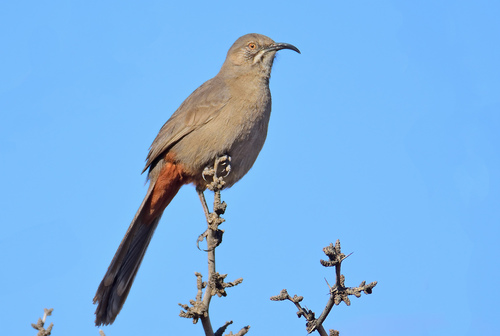
Crissal Thrasher
Toxostoma crissale
A master of the desert undergrowth, the Crissal Thrasher is famous for its sickle-shaped bill and beautiful, melodic song. Finding one is a challenge, making it a prized discovery for any backyard camera enthusiast.
Quick Identification
Size
Length: 10–12 in (25–30 cm); Wingspan: 12 in (30 cm); Weight: 2.1–2.4 oz (60–68 g)
Colors
Dull grayish-brown body, pale throat, dark malar (mustache) stripe, and distinctive deep rufous-chestnut undertail coverts. Eyes are straw-yellow to orange-brown.
Key Features
- Deeply decurved, sickle-shaped black bill
- Bright chestnut undertail coverts (the 'crissum')
- Plain, unstreaked grayish breast
- Long, rounded dark tail usually held cocked upward
When You’ll See Them
Geographic range
Where Does the Crissal Thrasher Live?
The Crissal Thrasher is a specialist of the arid Southwestern United States and Central Mexico. It is natively found across the Sonoran, Mojave, and Chihuahuan deserts, with its core populations residing in Arizona, New Mexico, Southern California, and West Texas. Its range extends south into the high-elevation scrublands of the Mexican Plateau, where it remains a year-round resident, rarely straying from the dense cover of its preferred brushy habitat.
Basemap © OpenStreetMap contributors
Behavior
Despite their reclusive nature, they are magnificent vocalists. Males typically sing from the hidden interior of a bush or, occasionally, from a prominent high perch during the cool hours of early spring mornings. Their song is a fluid, musical series of notes, often mimicking other birds but delivered with a softer, more melodic tone than the related Northern Mockingbird. They are solitary and highly territorial, remaining on their home range throughout the year.
EverydayEarth exclusive
Camera Tips
To capture the elusive Crissal Thrasher on a backyard camera, you must focus on the 'wild' edges of your property. These birds avoid open lawns and high-traffic areas, so place your camera at ground level—no higher than 12 inches—aimed at the base of dense shrubs or a thicket of desert broom or mesquite. Because they are ground-foragers, look for areas where organic debris and leaf litter have naturally collected; this is where they will spend their time digging for insects.
Water is the single best attractant for this species in arid environments. A ground-level birdbath or a simple recirculating water feature placed near dense cover is irresistible to them. Position your camera 3 to 5 feet away from the water source to ensure the bird remains in focus while maintaining a wide enough frame to catch its long tail. Setting the camera to 'Video' mode for 20-second clips is highly recommended, as it allows you to see their unique 'shoveling' foraging motion with their bill.
Trigger speed is critical. Crissal Thrashers are incredibly fast on their feet and often dash between shadows. Use a camera with a sub-0.5 second trigger speed to avoid getting 'blank' shots of a bird that has already run out of frame. If you are using a trail camera with a PIR sensor, set the sensitivity to 'High' to detect their movement through the brush. Early morning just after sunrise provides the best lighting and is their peak activity window.
Similar Species
Species that look similar or are commonly confused with Crissal Thrasher.
Curve-billed Thrasher
The Curve-billed has a heavily spotted breast and pale eyes, whereas the Crissal has a plain breast and dark rufous undertail coverts.
LeConte's Thrasher
LeConte's is much paler (sandy-colored) and prefers more open, sparsely vegetated saltbush flats rather than dense thickets.
California Thrasher
Found mostly in California chaparral; it has a similar shape but lacks the intense chestnut undertail color of the Crissal.
Frequently Asked Questions
Record Crissal Thrasher at your habitat
Connect a camera to start building your own species record — AI identifies every visitor automatically.