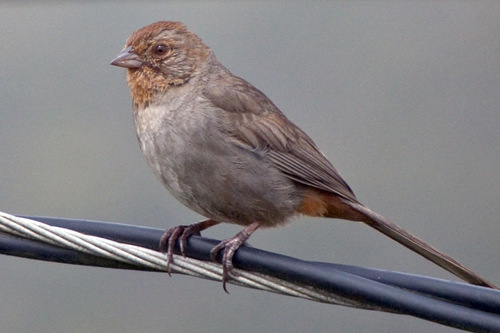
California Towhee
Melozone crissalis
The California Towhee is the loyal guardian of the Western garden. Known for its rich cinnamon accents and rhythmic ground-scratching, this chunky sparrow is a year-round delight for backyard birders.
Quick Identification
Size
Length: 20-25 cm (7.9-9.8 in); Wingspan: 29 cm (11.4 in); Weight: 37-67 g (1.3-2.4 oz)
Colors
Uniform matte dusty-brown body; rich cinnamon or rusty-orange patch under the tail (crissum) and around the base of the beak. Males and females are identical.
Key Features
- Long, rounded tail
- Dull matte-brown plumage with rusty undertail
- Thick, conical sparrow beak
- Large, chunky body for a sparrow
When You’ll See Them
Geographic range
Where Does the California Towhee Live?
Native to the western edge of North America, the California Towhee is found from southwestern Oregon through the coastal and interior valleys of California. Its range continues south into the Baja California peninsula of Mexico. It is a highly sedentary species, meaning it is a permanent resident that rarely travels more than a few miles from where it hatched, making it a reliable neighbor for backyard observers.
Basemap © OpenStreetMap contributors
Behavior
California Towhees are the quintessential "backyard birds" of the West Coast. While they lack the flashy colors of some songbirds, they make up for it with a bold, curious personality. They are primarily ground-dwellers, spending the vast majority of their time hopping through leaf litter or across suburban lawns. They are famously monogamous, with pairs often staying together year-round for several years, frequently seen foraging just a few feet apart and keeping in contact with sharp, metallic "chink" calls.
One of their most distinctive behaviors is the "double-scratch" foraging maneuver. To find food, the bird jumps forward and then kicks both feet backward simultaneously, clearing away dirt and leaves to reveal hidden seeds or insects. While they are relatively comfortable around human activity, they are highly territorial and will vigorously defend their patch of scrub or garden from other towhees, sometimes even attacking their own reflection in windows or car mirrors.
EverydayEarth exclusive
Camera Tips
To capture the best footage of a California Towhee, place your AI-powered camera low to the ground—ideally between 6 to 12 inches high. Since these birds are dedicated ground-foragers, a camera mounted on a high fence post looking down often misses the charming "double-scratch" behavior. Aim the lens toward the edge of a garden bed or underneath the canopy of a large shrub where the soil is moist or covered in mulch.
Using a ground-level tray feeder or simply scattering a handful of white proso millet or cracked corn on a flat stone will almost certainly bring them into view. They are creatures of habit; if they find a reliable food source, they will return to it at almost the same time every day. For the best lighting, position your camera facing North or South to avoid the harsh glare of the sun, which can wash out their subtle brown tones and make them look like silhouettes.
Because they are active year-round and do not migrate, you can get consistent results in any season. During the spring nesting season (March through June), they become much more vocal. Setting your camera to record video with high-quality audio will allow you to capture their metallic alarm calls and their unique accelerating, trilling song. If you have a birdbath, place the camera nearby; Towhees are frequent and enthusiastic bathers, providing excellent "action" shots when they splash.
Ensure your camera's motion sensitivity is set to a medium-to-high level. Because Towhees move in quick, jerky hops and can be surprisingly fast when they dart back into cover, a higher sensitivity ensures the shutter triggers before the bird leaves the frame. If your camera offers a "pre-roll" feature, enable it to catch the moment they fly down from a branch to start their ground-level patrol.
Similar Species
Species that look similar or are commonly confused with California Towhee.
Canyon Towhee
Nearly identical but found in interior deserts; has a paler breast with a small dark 'stickpin' spot in the center.
Spotted Towhee
Much flashier with a black head, white spots on the wings, and bright orange flanks.
Abert's Towhee
Found in desert riparian areas; has a distinctive black 'mask' around the base of the beak.
Frequently Asked Questions
Record California Towhee at your habitat
Connect a camera to start building your own species record — AI identifies every visitor automatically.