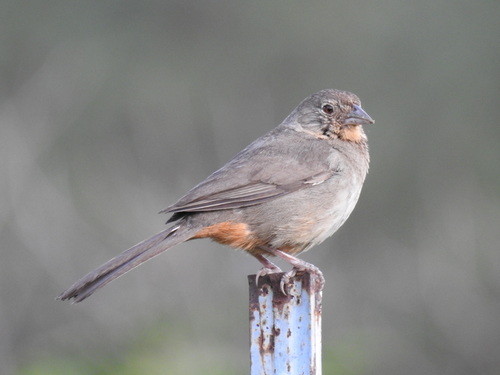
Canyon Towhee
Melozone fusca
The Canyon Towhee is the friendly, earth-toned neighbor of the American Southwest. A master of the desert floor, this curious bird is best known for its cinnamon-colored tail and its charming habit of investigating backyards with a bold, hopping gait.
Quick Identification
Size
Length: 8-10 in (20-25 cm); Wingspan: 11-12 in (28-30 cm); Weight: 1.3-2.4 oz (37-67 g)
Colors
Overall earthy gray-brown plumage with a warm cinnamon-red patch under the tail (the crissum), a buffy throat with faint dark spots, and a subtle rufous cap on the crown.
Key Features
- Cinnamon-orange undertail feathers
- Buff-colored throat with a small dark central spot
- Stocky body with a long, rounded tail
- Thick, conical seed-cracking beak
When You’ll See Them
Geographic range
Where Does the Canyon Towhee Live?
Native to the North American interior, the Canyon Towhee is a signature resident of the rugged landscapes of the American Southwest and Mexico. Its core range spans from the high plains of southeastern Colorado and the plateaus of New Mexico and Arizona, extending eastward into West Texas and southward deep into the central highlands and plateau regions of Mexico. Because they are non-migratory, these birds are permanent fixtures in their local ecosystems, providing year-round enjoyment for birdwatchers across the Chihuahuan and Sonoran deserts.
Basemap © OpenStreetMap contributors
Behavior
Canyon Towhees are the charming, ground-dwelling spirits of the desert Southwest. Unlike many flighty songbirds, they are remarkably bold and curious, often seen hopping across patios or peering into low windows. They are famous for their "double-scratch" foraging technique, where they hop forward and then kick both feet backward simultaneously to uncover seeds and insects hidden beneath the soil or leaf litter.
These birds are typically found in pairs, maintaining a strong, year-round bond. They communicate with sharp, metallic "cheep" calls that help them stay in contact while foraging through dense brush. While they can fly well, they prefer to run or hop away from danger, using their powerful legs to vanish into the safety of a nearby thicket or cactus patch. Their social nature and sedentary lifestyle mean that once a pair settles in your backyard, they are likely to remain your neighbors for many years.
EverydayEarth exclusive
Camera Tips
To capture high-quality footage of the Canyon Towhee, the most important rule is to think low. These are ground-specialists that rarely venture more than a few feet off the earth. Mount your AI-powered camera 6 to 12 inches above the ground, ideally angled slightly downward toward a flat, clear patch of dirt or a flat rock. This placement ensures you capture the bird's full profile and its characteristic "double-scratch" hopping motion rather than just the top of its head.
Baiting is highly effective for this species. Instead of using a hanging feeder, scatter white proso millet, cracked corn, or black oil sunflower seeds directly on the ground in front of the lens. To make your setup even more attractive, provide a shallow, ground-level birdbath. In the arid regions where these birds live, water is a premium resource. A slow-moving drip or a simple clay saucer filled with water will act as a magnet, bringing them right into the center of your camera’s frame.
Because Canyon Towhees are bold and often travel in pairs, set your camera to record longer video clips—at least 20 seconds. This allows you to observe their social interactions and vocalizations. Since they are active during the brightest parts of the day, try to position your camera so the sun is at its back (facing north or south) to avoid the harsh glare of the desert sun, which can wash out the subtle buff and cinnamon tones of their plumage. If you are using a trail camera, a high trigger speed is essential to capture their quick, jerky movements as they forage.
Similar Species
Species that look similar or are commonly confused with Canyon Towhee.
California Towhee
Very similar in appearance but restricted to the Pacific coast; it lacks the rufous crown often seen on the Canyon Towhee.
Abert's Towhee
Shares the same desert range but is easily distinguished by a dark black face mask around its bill.
Spotted Towhee
Much more brightly colored with a black hood, white spots on the wings, and bright rufous sides.
Frequently Asked Questions
Record Canyon Towhee at your habitat
Connect a camera to start building your own species record — AI identifies every visitor automatically.