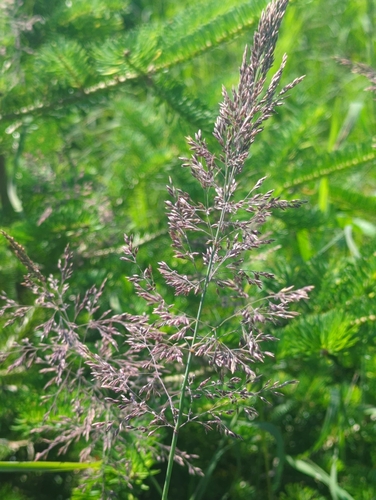
canadian bluejoint
Calamagrostis canadensis
A cornerstone of North American wetlands, Canadian Bluejoint adds a graceful, shimmering blue-green movement to any landscape. This resilient grass provides vital habitat for countless species, from nesting ducks to foraging mammals.
Quick Identification
Size
Stands 60–150 cm (24–60 inches) tall; seed heads 10–25 cm (4–10 inches) long
Colors
Blue-green foliage with purplish, bronze, or tan flowering panicles
Key Features
- Tall, slender stems with blue-green leaves
- Open, nodding seed heads with a purple-bronze tint
- Long, prominent ligule (3-8mm) where leaf meets stem
- Forms dense, sod-like mats via underground rhizomes
When You’ll See Them
Geographic range
Where Does the canadian bluejoint Live?
Canadian Bluejoint is a native powerhouse of North America, stretching from the subarctic reaches of Alaska and across every province in Canada. In the United States, its range extends through the Pacific Northwest, the Great Lakes region, and down the Appalachian corridor. While it is most dominant in northern latitudes and high-elevation meadows, it can be found in localized wetland pockets as far south as New Mexico and Arizona.
Basemap © OpenStreetMap contributors
Behavior
Canadian Bluejoint is a vigorous, cool-season perennial grass that defines many northern wetland landscapes. It begins its growth early in the spring, quickly producing a dense canopy of blue-green leaves that provides essential cover for nesting waterfowl and small mammals. Unlike many bunchgrasses, it spreads aggressively through a network of underground rhizomes, allowing it to colonize wet meadows and disturbed sites effectively.
While it is primarily a structural component of its ecosystem, its presence dictates the behavior of local wildlife. During the summer months, the tall stems create 'wildlife highways' where smaller creatures can move undetected by aerial predators. For humans, this grass is a vital tool in land restoration and erosion control, as its deep root systems stabilize soil along stream banks and marshy edges.
EverydayEarth exclusive
Camera Tips
Capturing Canadian Bluejoint on a trail camera requires a different strategy than photographing mobile wildlife. Because this grass is highly sensitive to wind, avoid placing your camera too close to the blades if you are using PIR (passive infrared) motion sensors, as the movement can cause hundreds of 'false' triggers on a breezy day. Instead, use the grass as a textured backdrop for your target species, or set your camera to a time-lapse mode to capture its growth and seasonal color changes.
To get the best visual results, position your camera at a low angle, roughly 12 to 18 inches off the ground. This perspective captures the elegant 'nodding' of the bronze seed heads against the sky and allows you to see the small mammals and ground-nesting birds that use the grass for cover. Side-lighting during the 'golden hours' of early morning or late afternoon will highlight the fine textures of the panicles and the distinct blue-green hue of the leaves.
If your goal is to document the wildlife interacting with the grass, place the camera near a transition zone where the Canadian Bluejoint meets open water or a forest edge. Animals like moose, deer, and various waterfowl frequent these areas for foraging and nesting. In late summer, the seed heads attract a variety of songbirds; a high-speed shutter setting or video mode is recommended to capture the quick movements of birds perched on the swaying stems.
In winter, don't pack your camera away. The dried, tan stalks of Canadian Bluejoint often remain standing through the snow, providing excellent contrast and structural interest. These 'skeletons' are often visited by wintering birds looking for leftover seeds or insects hiding in the stems, making it a year-round point of interest for your backyard or trail monitoring.
Similar Species
Species that look similar or are commonly confused with canadian bluejoint.
Frequently Asked Questions
Record canadian bluejoint at your habitat
Connect a camera to start building your own species record — AI identifies every visitor automatically.