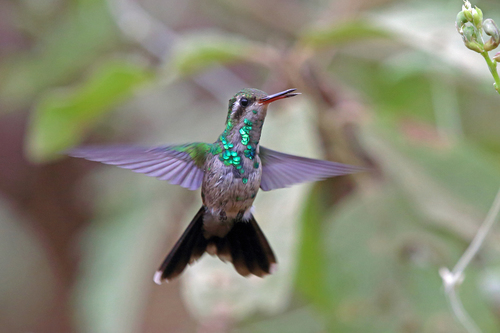
Canivet's Emerald
Cynanthus canivetii
A shimmering jewel of Central American landscapes, Canivet's Emerald is a feisty hummingbird famous for its glittering green plumage and dramatic forked tail. A resident beauty, it brings a flash of emerald energy to backyard gardens from Mexico to Costa Rica.
Quick Identification
Size
8-9 cm (3.1-3.5 in) in length; wingspan approx. 11 cm (4.3 in); weight 2.3-2.6 g (0.08-0.09 oz)
Colors
Males are glittering emerald green with a deeply forked blue-black tail and a red bill with a black tip. Females are bronzy-green above and grayish-white below, featuring a dark ear patch and a white stripe behind the eye.
Key Features
- Deeply forked, blue-black tail in males
- Glittering metallic green body plumage
- Red bill with a distinct black tip
- White post-ocular stripe behind the eye in females
When You’ll See Them
Geographic range
Where Does the Canivet's Emerald Live?
Native to the vibrant landscapes of Central America, Canivet's Emerald is a common resident of the tropical belt stretching from southeastern Mexico through the Pacific and Caribbean slopes. Its core range encompasses the diverse ecosystems of Belize, Guatemala, Honduras, El Salvador, and Nicaragua, reaching its southern limit in the northwestern regions of Costa Rica. These hummingbirds are largely non-migratory, remaining in their colorful home territories year-round to take advantage of the region's perpetual flowering seasons.
Basemap © OpenStreetMap contributors
Behavior
Canivet's Emeralds are high-energy, territorial hummingbirds known for their agile flight and bold personalities. Like many members of the emerald tribe, they are remarkably defensive over prime nectar sources, frequently engaging in high-speed mid-air chases to drive away competitors, including birds much larger than themselves. They are generally seen foraging at low to middle levels of the canopy, hovering momentarily before darting to the next blossom with characteristic precision.
While they are solitary foragers, they are frequently found in suburban gardens where flowering plants are abundant. They often employ a 'trap-lining' strategy, visiting a specific circuit of flowers throughout the day to ensure a steady supply of nectar. In social contexts, they are quite vocal, emitting dry, chattering 'tsip' calls while feeding or defending their territory, making them easy to locate by sound before they are seen.
EverydayEarth exclusive
Camera Tips
To capture the stunning iridescent feathers of the Canivet's Emerald, position your AI camera near red or orange tubular flowers, which are their preferred nectar sources. If you use a hummingbird feeder, set your camera roughly 3 to 5 feet away, angled slightly downward to catch the light reflecting off the bird's back and deeply forked tail. Since these birds move with incredible speed, ensure your camera is set to its fastest trigger speed or 'Action' mode to avoid motion blur.
Lighting is the most critical factor for this species. Try to place your camera so that it faces a dark, shaded background while the target area (the flower or feeder) is bathed in direct natural sunlight. This high contrast helps the AI recognition software identify the small profile of the bird and ensures the glittering emerald green plumage doesn't get washed out by a bright sky. If your camera allows for close-up focus, aim for a focal point about 12-18 inches from the feeder port.
Because they are year-round residents, you can capture them in any season, but the dry season often yields more concentrated activity as natural water and nectar sources become scarcer. Setting up a shallow, moving water feature or a misting birdbath can provide unique footage, as these emeralds love to fly through fine mists to bathe. Mount your camera at eye level (about 4-5 feet high) to get the most intimate 'face-to-face' shots of their striking red and black bills.
Similar Species
Species that look similar or are commonly confused with Canivet's Emerald.
Frequently Asked Questions
Record Canivet's Emerald at your habitat
Connect a camera to start building your own species record — AI identifies every visitor automatically.