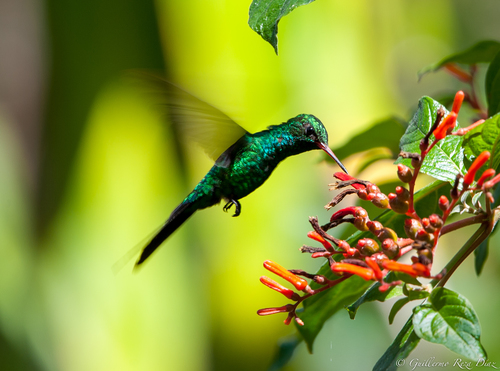
Cozumel Emerald
Cynanthus forficatus
An island treasure found only on Cozumel, this shimmering emerald hummingbird is famous for the male's dramatic, deeply forked tail.
Quick Identification
Size
8-10 cm (3.1-3.9 in) in length; weight approximately 2.3-3.5g
Colors
Males are metallic golden-green with a blue-tinged throat and a black, deeply forked tail. Females have grayish-white underparts and white tips on their outer tail feathers.
Key Features
- Extremely long, deeply forked black tail (males)
- Shimmering emerald green plumage
- Slender, slightly decurved bill
- Endemic exclusively to Cozumel Island
When You’ll See Them
Geographic range
Where Does the Cozumel Emerald Live?
Native to North America, the Cozumel Emerald is a true island specialist. It is found exclusively on Cozumel Island, which sits just off the coast of Mexico's Yucatán Peninsula in the Caribbean Sea. Because its entire global population is confined to this single island, it is one of the most geographically restricted bird species in the region.
Basemap © OpenStreetMap contributors
Behavior
The Cozumel Emerald is a high-energy, territorial bird that dominates the flowering patches of its island home. Like most hummingbirds, it spends a significant portion of its day in a cycle of rapid-fire foraging followed by periods of perching to digest and defend its territory. Males are particularly bold, often seen performing aerial displays or chasing away rivals from prime nectar sources.
In backyard settings, they are curious and can become quite accustomed to human presence, especially if consistent food sources like feeders or native flowers are available. They are solitary outside of the breeding season, though several may congregate peacefully near a particularly abundant food source, provided there is enough space to maintain a 'buffer zone.'
EverydayEarth exclusive
Camera Tips
To capture the stunning iridescent green of the Cozumel Emerald, camera placement is everything. Position your AI-powered camera within 3 to 5 feet of a nectar-rich food source, such as a hummingbird feeder or native flowering bushes like Firebush (Hamelia patens). Because these birds are incredibly fast, ensure your camera is set to its highest possible shutter speed or 'Sports' mode to freeze the motion of their wings, which can beat up to 80 times per second.
Angle is crucial for hummingbirds; try to position the camera so the sun is behind you or hitting the bird from the side. This lighting setup allows the metallic feathers to catch the light and 'glow' on film. Avoid placing the camera where it faces directly into a bright sky, as this will result in a dark silhouette rather than a colorful portrait. Aim the lens at a height of 4 to 5 feet, which is the typical hovering height for foraging.
If you want to capture more than just a blur of green, set up a 'perch' near the feeder—a thin, bare twig or a specialized hummingbird swing. These birds love to survey their territory from a high-visibility spot between feedings. If your camera has a 'pre-roll' or high-speed trigger function, enable it, as the time between a hummingbird appearing and disappearing can be less than a second. In Cozumel's tropical environment, keep your lens clean of salt spray or humidity fogging for the clearest images.
Similar Species
Species that look similar or are commonly confused with Cozumel Emerald.
Frequently Asked Questions
Record Cozumel Emerald at your habitat
Connect a camera to start building your own species record — AI identifies every visitor automatically.