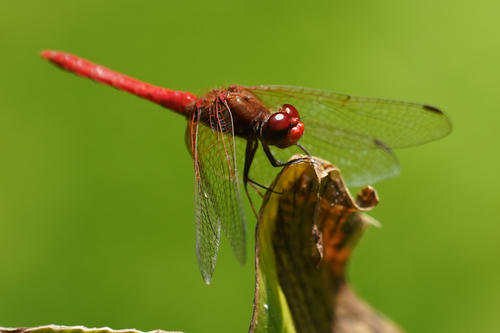
Cardinal Meadowhawk
Sympetrum illotum
The Cardinal Meadowhawk is a vibrant flash of scarlet in the summer sky, known for its bold personality and striking red wings. A frequent visitor to backyard ponds, it is one of nature's most effective—and beautiful—mosquito hunters.
Quick Identification
Size
33-44 mm (1.3-1.7 in) in length; wingspan of 50-65 mm (2-2.5 in)
Colors
Mature males are brilliant scarlet red; females and juveniles are golden-yellow to olive-brown
Key Features
- Vibrant red body and face in mature males
- Amber-colored patches at the base of all four wings
- Lack of black spots on the side of the abdominal segments
- Reddish-brown stigmas on the leading edge of wings
When You’ll See Them
Geographic range
Where Does the Cardinal Meadowhawk Live?
Native to the western half of North America, the Cardinal Meadowhawk is a common sight from British Columbia down through the western United States and Mexico. Its range extends significantly further south into Central America, the northern reaches of South America, and across several islands in the Caribbean. Because it is highly adaptable to man-made water sources, it is one of the most frequently spotted red dragonflies in suburban backyard environments within its range.
Basemap © OpenStreetMap contributors
Behavior
The Cardinal Meadowhawk is a classic "percher," a dragonfly that spends the majority of its day resting on the tips of tall grasses, twigs, or garden stakes. From these vantage points, they act as vigilant sentinels, scanning the sky for passing prey. When an insect is spotted, they launch into a rapid, acrobatic flight to intercept it in mid-air before returning to the same or a nearby perch to eat.
During the breeding season, males become highly territorial and can be seen patrolling the perimeter of ponds or slow-moving streams. They are surprisingly bold and will aggressively chase away other dragonflies, even those larger than themselves. Unlike many other dragonfly species that are only seen at the height of summer, Cardinal Meadowhawks are known for their long flight season, often appearing early in the spring and remaining active well into the autumn months.
EverydayEarth exclusive
Camera Tips
To capture high-quality images of a Cardinal Meadowhawk, you must take advantage of their perching behavior. These dragonflies are creatures of habit and will often return to the exact same twig or reed dozens of times a day. Place your camera on a tripod or mount it approximately 2 to 4 feet off the ground, aimed directly at a prominent, isolated perch near a pond or birdbath. If your garden lacks a natural perch, simply stick a bamboo stake or an attractive dry branch into the ground near water to create a "landing pad" for them.
Because dragonflies are sensitive to movement, using a remote-triggered camera or a motion-activated AI camera is ideal. Set your camera to a fast shutter speed (at least 1/1000s) to freeze the motion of their wings, which beat at incredible speeds. Since these insects are most active in direct sunlight, mid-day is the best time for action shots, but the "golden hour" of late afternoon will make the male's cardinal-red body appear even more luminous and saturated in your photos.
For the best results, position the camera so the sun is behind you, illuminating the dragonfly's body and the amber patches at the base of its wings. If your camera has a macro mode or a close-focusing lens, use it; these dragonflies are small, and filling the frame requires getting within 1-2 feet of the perch. Avoid using a flash during the day, as it can create harsh reflections off their translucent wings and compound eyes. Instead, rely on natural light to capture the intricate vein patterns that make this species so unique.
Similar Species
Species that look similar or are commonly confused with Cardinal Meadowhawk.
Flame Skimmer
Larger body with much more extensive orange/red saturation across the wings, rather than just at the base.
Autumn Meadowhawk
Slightly smaller with yellow or pale legs, whereas the Cardinal Meadowhawk has darker legs.
Variegated Meadowhawk
Has a more complex pattern on the abdomen with distinct white and black markings along the sides.
Frequently Asked Questions
Record Cardinal Meadowhawk at your habitat
Connect a camera to start building your own species record — AI identifies every visitor automatically.