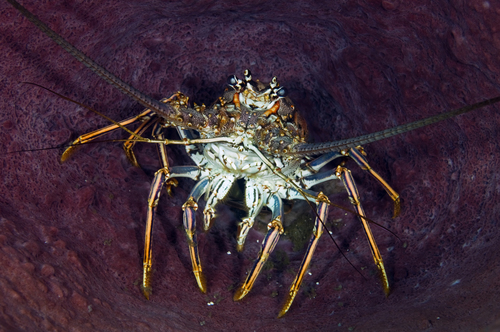
Caribbean Spiny Lobster
Panulirus argus
The Caribbean Spiny Lobster is a master of the night, known for its vibrant spotted shell and the incredible 'conga line' migrations it performs across the ocean floor. Unlike its clawed relatives, this social crustacean uses its massive antennae to navigate and defend its reef home.
Quick Identification
Size
Body length typically 20-40 cm (8-16 in), reaching up to 60 cm (24 in); weight ranges from 0.7-1.4 kg (1.5-3 lbs), though large males can exceed 5 kg (11 lbs).
Colors
Mottled patterns of brown, olive, and mahogany with prominent white spots on the abdomen; legs are striped with blue and yellow.
Key Features
- Two oversized, whip-like spiny antennae
- Large, forward-pointing spines over the eyes
- Four pairs of conspicuous white spots on the tail
- Completely lacks the large front claws found in Maine lobsters
When You’ll See Them
Geographic range
Where Does the Caribbean Spiny Lobster Live?
The Caribbean Spiny Lobster is a hallmark species of the tropical Western Atlantic. Its range begins as far north as the waters off North Carolina and extends southward through the entire Caribbean Sea, the Gulf of Mexico, and down to the coast of Brazil. They are particularly abundant in the shallow shelf waters surrounding the Bahamas, the Florida Keys, and the various island nations of the Antilles. While they are native to these warm currents, their planktonic larvae can occasionally be swept further north by the Gulf Stream, though they rarely establish permanent colonies in temperate zones.
Basemap © OpenStreetMap contributors
Behavior
The Caribbean Spiny Lobster is a primarily nocturnal creature that spends its daylight hours tucked deep within the crevices of coral reefs, under ledges, or beneath the protective roots of mangroves. Unlike their northern cousins, these lobsters are highly social and often share their daytime shelters with several other individuals. They use their long, sensitive antennae to detect predators and maintain contact with their neighbors in the dark.
One of their most fascinating behaviors is the seasonal "lobster march." During the first major cold front of autumn, hundreds of lobsters form long, single-file lines on the ocean floor, maintaining contact with the individual in front of them using their antennae. This mass migration allows them to move to deeper, more stable waters for the winter, minimizing drag and providing collective protection against predators like triggerfish and octopuses.
While generally shy, they are incredibly defensive of their hiding spots. If threatened, they use their powerful abdominal muscles to rapidly flip their tail, propelling themselves backward at high speeds. They also produce a loud, rasping stridulatory sound—much like a violin—by rubbing the base of their antennae against a specialized file-like structure under their eyes to startle potential attackers.
EverydayEarth exclusive
Camera Tips
Capturing the Caribbean Spiny Lobster requires an underwater camera setup, but for those with docks or beachfront property, this is surprisingly achievable. Use a waterproof trail camera or a specialized underwater housing with a time-lapse or motion-trigger feature. For the best results, mount the camera 12-18 inches off the sandy bottom, angled slightly upward toward a known reef crevice or limestone ledge where lobsters are likely to hide during the day.
Since these lobsters are strictly nocturnal foragers, artificial lighting is essential. Use a camera with a high-quality infrared flash to avoid startling the animals, as white light may cause them to retreat back into their holes. If you are using a dock-mounted camera, try to position it near a piling with significant growth, as lobsters often forage around the base of structures for small mollusks and crustaceans.
Baiting is an effective way to bring them into the frame. Place a perforated PVC pipe filled with crushed fish carcasses or oily sardines (a "scent tube") about three feet in front of the lens. The scent will travel with the current, drawing lobsters out from their ledges. Secure the bait tube firmly to the bottom to prevent larger scavengers like nurse sharks or rays from dragging it out of the camera's field of view.
If you are looking to capture the famous "lobster march," timing is everything. Monitor local weather reports for the first significant cold front in October or November. Set your camera to take rapid-fire bursts or high-definition video, as the lobsters move surprisingly quickly when they are in their migratory lines. Check your lens regularly for biofouling or algae growth, which can happen in as little as 48 hours in warm tropical waters.
Similar Species
Species that look similar or are commonly confused with Caribbean Spiny Lobster.
Spotted Spiny Lobster
Smaller with much smaller white spots over the entire body, including the legs and antennae, whereas P. argus has large spots primarily on the tail.
California Spiny Lobster
Found in the Pacific; lacks the prominent four white spots on the tail and has a more uniform reddish-brown color.
Frequently Asked Questions
Record Caribbean Spiny Lobster at your habitat
Connect a camera to start building your own species record — AI identifies every visitor automatically.