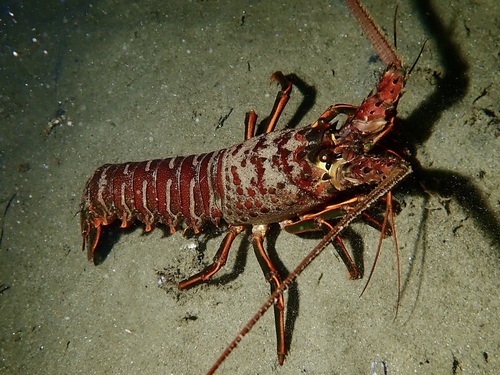
California Spiny Lobster
Panulirus interruptus
The California Spiny Lobster is the 'red ghost' of the Pacific kelp forests. Lacking the heavy claws of its Atlantic relatives, this spiny wanderer uses its massive antennae and nocturnal stealth to navigate the rocky reefs of the West Coast.
Quick Identification
Size
Typically 25–30 cm (10–12 in), but can reach up to 60 cm (24 in). Weighs up to 12 kg (26 lbs).
Colors
Rich reddish-brown to brick red or deep purple. Legs feature lighter longitudinal stripes; underbelly is pale cream to tan.
Key Features
- Two massive, thick, spiny antennae longer than the body
- Distinct lack of large front claws (pincers)
- Interrupted transverse grooves across each tail segment
- Sharp spines covering the carapace and antennae base
When You’ll See Them
Sightings on EverydayEarth
Mar 17, 2026
A California spiny lobster navigates across the rocky reef floor in a kelp forest. It moves toward the center of the frame, passing by a purple sea urchin while kelp fronds sway in the background.
Jul 30, 2026
A California Spiny Lobster crawls across the sandy and rocky seabed, navigating through thick kelp fronds. It moves purposefully, using its long antennae to probe the environment ahead as it travels through the underwater forest.
Jul 27, 2026
A California Spiny Lobster navigates the vibrant seafloor of a kelp forest. It crawls over rocks encrusted with pink coralline algae and past several purple sea urchins. The lobster's long antennae sweep the water ahead as it moves into the shelter of swaying giant kelp fronds.
Jul 25, 2026
A California Spiny Lobster is seen actively crawling across the sandy ocean floor and over kelp fronds. It uses its long antennae to probe its surroundings while moving purposefully past a rocky outcrop covered in purple algae.
Jul 14, 2026
A California Spiny Lobster navigates the sandy and rocky terrain of the kelp forest floor. It uses its long antennae to sense the environment while crawling past kelp fronds and rocks covered in pink algae. The footage ends with a detailed close-up of the lobster's spiny carapace and eyes.
Jun 15, 2026
A California Spiny Lobster crawls across a rocky reef, using its long antennae to probe the environment as it moves past a purple sea urchin and swaying kelp fronds.
Geographic range
Where Does the California Spiny Lobster Live?
Native to the Eastern Pacific coastline of North America, the California Spiny Lobster thrives in the nutrient-rich waters between Monterey Bay and the southern tip of Baja California. While its core population is centered in the Southern California Bight, its range extends as far south as the Gulf of Tehuantepec in Mexico, making it a signature species of the Pacific's temperate and subtropical rocky reefs.
Basemap © OpenStreetMap contributors
Recorded on EverydayEarth
Behavior
The California Spiny Lobster is a primarily nocturnal creature that spends its daylight hours tucked deep within the protective crevices of rocky reefs or the shadows of kelp forests. They are social yet cautious, often congregating in groups within a single 'den' to keep watch for predators like giant sea bass or sheephead. When threatened, they use a powerful abdominal reflex to swim backward rapidly, escaping into deeper water.
Unlike many other crustaceans, these lobsters lack the heavy claws seen in their Atlantic cousins. Instead, they rely on their spiny exoskeleton and 'stridulation' for defense. By rubbing the base of their antennae against a specialized file-like structure on their head, they produce a loud, raspy screeching sound intended to startle predators. They are also known for seasonal migrations, moving into shallower waters during the warm summer months to molt and mate before retreating to deeper, more stable offshore environments during the winter storm season.
EverydayEarth exclusive
Camera Tips
Capturing the California Spiny Lobster on camera requires a specialized underwater setup, as these animals never leave the water. For those with 'backyard' access to a pier, dock, or tide pool, an underwater action camera or a dedicated submersible trail camera is essential. Mount your camera at the base of a rocky ledge or near the entrance of a visible crevice. Since they are strictly nocturnal, you will need a camera with strong infrared (IR) capabilities or a low-lumen red light. White light often causes them to retreat quickly into their holes, but they are less sensitive to red spectrum light.
Placement is everything. Look for 'lobster dens'—crevices where you can see the long, whip-like antennae poking out during the day. Angle the camera slightly upward toward the crevice entrance from about 2 feet away to capture their full body when they emerge at dusk. If you are using a camera in a shallow tide pool, ensure it is weighted or tethered to a rock, as even moderate surge can shift your frame. To encourage a lobster to stay in the frame longer, you can use a scent lure. A small mesh bag filled with crushed mussels or oily fish like mackerel, secured just in front of the lens, will keep them busy scavenging while you capture high-quality footage.
Be mindful of the tide and moon cycles. Lobsters are most active on the darkest nights, especially during new moons, when they feel safest from visual predators. If your camera allows for time-lapse, set it to trigger every 30 seconds between sunset and sunrise. This will allow you to see the social dynamics as multiple lobsters may leave and enter the same den throughout the night. Check your lens for 'marine snow' or silt buildup weekly, as the Pacific surge can quickly obscure your view.
Similar Species
Species that look similar or are commonly confused with California Spiny Lobster.
Frequently Asked Questions
Record California Spiny Lobster at your habitat
Connect a camera to start building your own species record — AI identifies every visitor automatically.