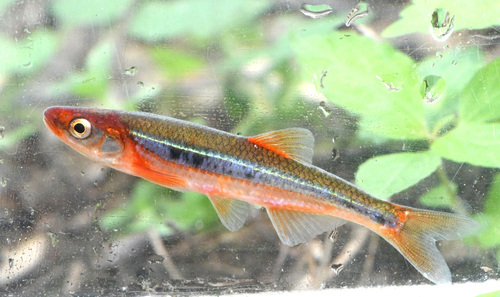
Carmine Shiner
Notropis percobromus
A hidden gem of North American streams, the Carmine Shiner transforms from a subtle silver minnow into a brilliant, red-headed marvel during the spring spawn.
Quick Identification
Size
Small and slender, typically reaching 5 to 8 cm (2 to 3.1 inches) in length.
Colors
Silvery-blue iridescent sides with a white belly; breeding males develop a vibrant carmine-red head and fin bases.
Key Features
- Slender, streamlined body shape
- Carmine red snout and head during spawning
- Pointed snout with a large, terminal mouth
- Transparent fins with occasional reddish tint
When You’ll See Them
Geographic range
Where Does the Carmine Shiner Live?
Native to the North American continent, the Carmine Shiner is primarily centered in the central United States within the Mississippi River basin. Its core range includes the Ozark Highlands of Missouri, Arkansas, and Oklahoma, extending into the eastern Great Plains. Isolated but significant populations also exist further north in the Red River of the North drainage, reaching into parts of Manitoba, Canada, where the species is often a focus of local conservation efforts due to its sensitivity to water quality.
Basemap © OpenStreetMap contributors
Behavior
The Carmine Shiner is a highly active, schooling fish known for its agility in flowing water. These minnows are social creatures, often found in large groups navigating the mid-water columns of clear streams. They are sight-feeders, meaning they rely on their keen vision to spot movement on the water's surface or drifting through the current.
During the spring and early summer spawning season, their behavior becomes more localized as they congregate over gravelly riffles. They are often observed following larger fish species, like Chubs, to utilize their nests for egg-laying. While they are generally shy around humans, their curious nature makes them a delight to observe in clear-water environments where they may approach a submerged lens if it remains still.
EverydayEarth exclusive
Camera Tips
To capture the Carmine Shiner, an underwater 'action' camera or a dedicated submersible trail camera is essential. Position the camera in a 'riffle'—a shallow section of the stream where water ripples over rocks. Use a weighted mount or a heavy stone to secure the camera 4-6 inches above the gravel bed, angling it slightly upward toward the water's surface to catch the light reflecting off their silvery scales.
Timing is everything for this species. Aim to record during the late morning to early afternoon when the sun is directly overhead; this penetrates the water column best and highlights the iridescent blue and carmine red hues. If you are filming during the spring spawning season, look for 'nests'—circular patches of clean gravel—where males will be most active and colorful.
Because these fish are sensitive to vibrations, avoid walking in the water near the camera after it is set. Use a high frame rate (60fps or higher) if your camera allows, as these minnows move with sudden, darting bursts of speed. Natural light is your best friend here, so avoid using artificial LEDs which can reflect harshly off the fish's metallic sides and spook the school.
Similar Species
Species that look similar or are commonly confused with Carmine Shiner.
Frequently Asked Questions
Record Carmine Shiner at your habitat
Connect a camera to start building your own species record — AI identifies every visitor automatically.