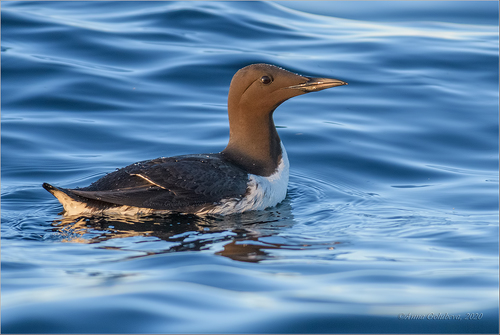
Common Murre
Uria aalge
Often called the 'Northern Penguin,' the Common Murre is a master of the deep sea. Witness their incredible cliff-side colonies and high-speed underwater flights through the lens of coastal wildlife cameras.
Quick Identification
Size
Length: 38–46 cm (15–18 in); Wingspan: 61–73 cm (24–29 in); Weight: 945–1,044 g (2.1–2.3 lbs)
Colors
Deep black or dark chocolate-brown head, neck, and back with stark white underparts. In winter, the throat and face turn white with a dark line trailing behind the eye.
Key Features
- Long, pointed black dagger-like bill
- Upright, penguin-like posture when on land
- Thin dark line extending back from the eye in winter plumage
- Dense, white-bellied underparts contrasting with dark upperparts
When You’ll See Them
Geographic range
Where Does the Common Murre Live?
Native to the northern latitudes of the Northern Hemisphere, the Common Murre thrives across the North Atlantic and North Pacific oceans. Its core range includes the rugged coastlines of the United Kingdom, Norway, Iceland, and Canada, as well as the United States from Alaska down to central California. These birds are primarily found in cold, productive marine waters, migrating only from their high-latitude breeding cliffs to slightly more temperate open waters during the harsh winter months.
Basemap © OpenStreetMap contributors
Behavior
Common Murres are highly social seabirds that spend the vast majority of their lives at sea, coming to land only to breed. They are famous for nesting in incredibly dense colonies on narrow cliff ledges, often standing shoulder-to-shoulder with thousands of others. This proximity helps protect them from predators like gulls, though the noise and activity levels are intense. They do not build nests; instead, they lay a single, distinctly pear-shaped egg directly on the rock, a design that causes the egg to spin in a circle rather than roll off the edge.
In the water, these birds are spectacular athletes. While they look somewhat awkward taking off from the surface, they are powerful 'wing-propelled' divers. They use their wings like flippers to 'fly' underwater, reaching depths of over 100 meters (330 feet) in search of schooling fish. Their interaction with humans is usually limited to coastal sightings, though they are highly sensitive to oil spills and changes in fish populations caused by climate change.
EverydayEarth exclusive
Camera Tips
Capturing the Common Murre on camera requires a specialized approach since they are rarely 'backyard' guests unless your backyard is a coastal cliff. If you live near a known colony, position your camera on a stable, tripod-mounted setup overlooking rocky ledges. Use a wide-angle lens to capture the scale of the colony, or a telephoto lens for intimate portraits of pairs 'allopreening' (grooming each other). Because of the high-contrast black and white plumage, slightly underexpose your shots to avoid blowing out the white feathers in bright sunlight.
Salt spray and high winds are your biggest enemies when placing cameras near Murre habitats. Use a high-quality weather-sealed housing or a waterproof 'dry box' for your camera body. Periodically wipe the lens with a microfiber cloth and fresh water to prevent salt crusting, which will blur your images. If using a trail camera, ensure it is securely tethered; coastal gusts can easily dislodge gear from cliffside perches.
The best time for action shots is during the 'jumpling' phase in late summer. This is when the chicks, only three weeks old and still flightless, leap off the cliffs into the ocean to join their fathers. Set your camera to a high shutter speed (1/2000s or faster) to freeze the motion of these dramatic plunges. Early morning light provides the best texture on the dark feathers, revealing the subtle browns and blacks that distinguish them from other auks.
Similar Species
Species that look similar or are commonly confused with Common Murre.
Thick-billed Murre
Look for a shorter, stouter bill with a prominent white line along the cutting edge of the upper mandible.
Razorbill
Features a much heavier, deep, vertically-flattened bill with white markings, and a more pointed tail when swimming.
Pigeon Guillemot
Smaller with bright red feet and a large white wing patch containing a black wedge.
Frequently Asked Questions
Record Common Murre at your habitat
Connect a camera to start building your own species record — AI identifies every visitor automatically.