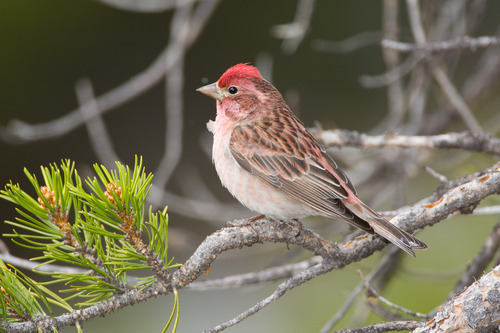
Cassin's Finch
Haemorhous cassinii
The Cassin's Finch is the quintessential songbird of the high country, sporting a brilliant red cap and a voice that echoes through the pines. Learn how to spot this mountain gem and capture its vibrant colors on your backyard camera.
Quick Identification
Size
Length: 16 cm (6.3 in); Wingspan: 25–30 cm (10–12 in); Weight: 24–34 g (0.8–1.2 oz)
Colors
Males have a bright red peaked crown, pale pinkish throat/breast, and brown streaked back; females are olive-brown with sharp dark streaking on white underparts.
Key Features
- Bright red peaked crown on males
- Fine dark streaking on white undertail coverts
- Large, straight-edged conical bill
- Pale, distinct eye-ring
- Distinctive 'che-up' call in flight
When You’ll See Them
Geographic range
Where Does the Cassin's Finch Live?
Cassin's Finch is a characteristic bird of the mountainous western regions of North America. Its native range stretches from the southern interior of British Columbia through the Rocky Mountains, the Cascades, and the Sierra Nevada, reaching deep into the volcanic highlands of central Mexico. While many populations are resident year-round in the western United States, others are altitudinal migrants, moving to lower valleys or further south into Mexican territories when winter snow covers their high-country food sources.
Basemap © OpenStreetMap contributors
Behavior
Cassin's Finches are highly social and energetic birds that spend much of their time in the upper canopies of coniferous forests. They are known for their nomadic tendencies, often moving in large flocks in search of localized food sources like pine seed crops. Their flight is undulating and accompanied by a cheerful, diagnostic call that makes them easy to identify even before they land.
In backyard settings, they are frequent visitors to feeders, particularly in mountain communities. While they can be bold around feeders, they remain wary of ground-level predators. They exhibit fascinating social structures during the winter, often forming mixed-species flocks with other finches, yet they maintain a distinct 'pecking order' when competing for perches. They are also known for their impressive singing ability, with males often mimicking the songs of other birds to enhance their own complex melodies.
EverydayEarth exclusive
Camera Tips
To capture the best footage of Cassin's Finch, elevation and environment are key. These birds are most comfortable in the mid-to-upper canopy, so if you are placing a camera on a feeder, try to elevate it at least 5 to 6 feet off the ground near evergreen trees. Use a wide-angle lens if your camera is placed inside a birdhouse-style feeder, as their 'peaked' crown is their most defining feature and requires a clear view of the head. If your camera allows for manual focus, set it specifically for the perch distance to capture the fine detail of the male's red crown feathers.
Food and water are the primary attractants. Black oil sunflower seeds and hulled sunflower hearts are irresistible to them. However, in the dry mountain air, a birdbath—especially one with a heater for winter or a small dripper for summer—is a magnet for Cassin's Finches. Position your camera to face West or North to avoid lens flare during their peak morning activity hours. The soft morning light will beautifully illuminate the rose-colored plumage of the males, providing much higher quality video than the harsh midday sun.
For trail camera enthusiasts, look for natural mineral deposits or salt licks. Cassin's Finches are known to seek out minerals in the soil, and a camera placed low to the ground near these spots can capture unique foraging behaviors rarely seen at feeders. Set your camera to 'Burst Mode' with 3-5 photos per trigger, as these birds are quick and twitchy; multiple shots increase your chances of getting a perfectly sharp image of their distinctive crest in its upright position.
Similar Species
Species that look similar or are commonly confused with Cassin's Finch.
Frequently Asked Questions
Record Cassin's Finch at your habitat
Connect a camera to start building your own species record — AI identifies every visitor automatically.