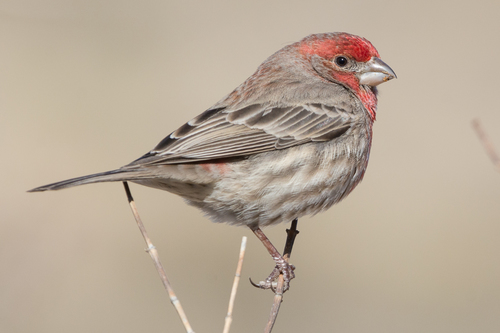
House Finch
Haemorhous mexicanus
The House Finch is a cheerful, rosy-hued songbird that has mastered the art of living alongside humans. Known for its sweet warbling song and social spirit, it is a favorite visitor for backyard observers across North America.
Quick Identification
Size
Length: 12.5–15 cm (5–6 in); Wingspan: 20–25 cm (8–10 in); Weight: 16–27 g (0.6–0.9 oz)
Colors
Males feature a rosy-red head, throat, and rump with brown-streaked bellies; females are overall grayish-brown with heavy, blurry streaking.
Key Features
- Heavy, blunt-tipped conical beak
- Square-tipped tail with a slight notch
- Heavy brown streaking on the lower belly and flanks
- Vibrant red or orange 'bib' and cap on adult males
When You’ll See Them
Sightings on EverydayEarth
May 20, 2026
A male House Finch is seen feeding a fledgling on the bird feeder tray. The younger bird exhibits classic begging behavior, keeping its beak wide open and fluttering its wings while the adult retrieves seeds to feed it.
Mar 3, 2026
Various bird species visit the feeder tray in quick succession to forage. Initially, a male House Finch and an American Tree Sparrow are present. They are later replaced by a pair of House Sparrows (male and female). The sequence ends with an American Robin landing abruptly on the rim of the tray, filling the camera's view.
Jun 13, 2026
A female Rose-breasted Grosbeak and a male House Finch are perched together on an orange fruit feeder, both busy eating grape jelly. The larger grosbeak dominates the left side of the frame while the smaller finch feeds on the right. After a few moments of feeding, the finch flies away first, followed shortly by the grosbeak.
Jun 6, 2026
A male House Finch is perched on the edge of an orange feeder, looking towards the camera. The feeder contains fruit slices and grape jelly, positioned against a lush green backdrop of pine trees and residential scenery.
May 28, 2026
A male House Finch lands on the edge of a red oriole feeder containing orange slices. It leans down several times to feed from the central reservoir before looking directly at the camera and then hopping toward the side.
May 11, 2026
A male House Finch perches on the edge of the tray feeder, searching for seeds. It hops through the mix of sunflower seeds and corn, occasionally pausing to look around before continuing to feed.
Geographic range
Where Does the House Finch Live?
Originally native to the desert southwest of the United States and most of Mexico, the House Finch has become one of the most successful avian colonizers in North America. After a small population was released on Long Island in 1940, the species rapidly expanded across the eastern United States and southern Canada, eventually meeting their western counterparts in the Great Plains. Today, they are a permanent resident across the entire continental United States, much of southern Canada, and the Mexican plateau, with additional introduced populations thriving in the Hawaiian Islands.
Basemap © OpenStreetMap contributors
Recorded on EverydayEarth
Behavior
House Finches are incredibly social and gregarious birds, often seen in small flocks or family groups throughout the year. They are remarkably adapted to human environments, showing little fear of people and frequently nesting in hanging planters, wreaths, or building ledges. In the wild, they are active foragers that move with a bouncy, undulating flight pattern, often calling out with a sharp 'cheep' while in the air.
These birds are known for their beautiful, long-winded warbling songs which the males use to defend small territories and attract mates. Unlike many other finches, House Finches are almost exclusively vegetarian, even when feeding their young. They are frequent visitors to bird feeders and birdbaths, where they may occasionally compete for space with House Sparrows or Goldfinches.
EverydayEarth exclusive
Camera Tips
To capture high-quality footage of House Finches, the most effective strategy is to position your camera near a high-volume bird feeder. These birds are particularly attracted to tube feeders filled with black oil sunflower seeds or hopper feeders with mixed birdseed. Mount your camera about 12 to 18 inches away from the feeder port for a clear, frame-filling shot. Because House Finches often travel in groups, a wider-angle lens can help capture the social dynamics and occasional squabbles that occur when multiple birds land at once.
Water is another powerful lure for this species. House Finches are frequent bathers and drinkers, especially in drier climates. Placing a camera near a shallow birdbath or a solar-powered fountain will provide excellent opportunities to record their energetic bathing behavior. Ensure the camera is positioned at a low angle, roughly level with the water's surface, to capture the splashing and the intricate details of their plumage when wet.
For the best lighting, aim to have the sun behind your camera during the early morning hours. This 'golden hour' light will make the male's red feathers pop with incredible vibrancy. If you are using a trail camera, set it to 'Photo + Video' mode with a short trigger delay, as these birds move quickly and frequently fly off and return. During the spring, look for nests in nearby ivy or porch ornaments; placing a camera a safe distance away can provide a fascinating window into their nesting habits, though care should be taken never to disturb the nest site.
Similar Species
Species that look similar or are commonly confused with House Finch.
Purple Finch
Purple Finches have more extensive reddish-pink plumage across the back and wings, and lack the heavy brown side-streaking seen on House Finches.
Cassin's Finch
Cassin's Finches are slightly larger with a distinct peaked crown and a finer, more pointed beak.
House Sparrow
While similar in size, House Sparrows have thicker necks, gray crowns, and lack the red plumage and heavy belly streaking of the House Finch.
Frequently Asked Questions
Record House Finch at your habitat
Connect a camera to start building your own species record — AI identifies every visitor automatically.