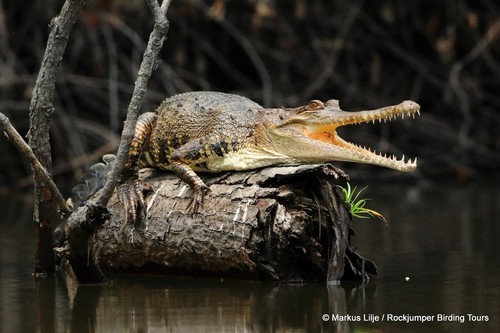
Central African slender-snouted crocodile
Mecistops leptorhynchus
A master of the Congo's hidden waterways, the Central African slender-snouted crocodile is a prehistoric relic with a specialized snout built for lightning-fast fishing. This elusive reptile remains one of Africa's most mysterious and critically endangered predators.
Quick Identification
Size
2.5–4 meters (8.2–13.1 feet) in length; weighing 125–325 kg (275–715 lbs)
Colors
Olive to dark brown back with irregular black blotches; yellowish or cream-colored underbelly; juveniles are lighter tan with distinct dark bands
Key Features
- Extremely narrow and elongated snout
- Heavy, shield-like scales on the back and neck
- Lack of a bony ridge between the eyes
- Yellowish-tan underside without dark spots
When You’ll See Them
Geographic range
Where Does the Central African slender-snouted crocodile Live?
Native to the heart of the African continent, the Central African slender-snouted crocodile thrives within the massive Congo River basin and its surrounding tributaries. Its core range spans across Central Africa, including the dense rainforests of the Democratic Republic of the Congo, Gabon, Cameroon, and the Republic of the Congo. Unlike its West African relative, this species is strictly a freshwater specialist, rarely venturing into the brackish estuaries or coastal mangroves of the Atlantic coast.
Basemap © OpenStreetMap contributors
Behavior
The Central African slender-snouted crocodile is a reclusive and primarily aquatic reptile that spends much of its time submerged or basking on fallen logs near deep river channels. Unlike the more aggressive Nile crocodile, this species is relatively shy and avoids human contact whenever possible. They are semi-social during the breeding season but generally lead solitary lives, defending specific stretches of riverbank where they find the best hunting and basking spots.
These crocodiles are highly vocal, using a variety of barks and chirps to communicate with mates or offspring. They are particularly known for their unique nesting behavior; females construct large mounds of vegetation rather than digging holes in the sand, utilizing the heat from decaying organic matter to incubate their eggs. While they are apex predators in their niche, they are rarely a threat to humans unless provoked or guarding a nest.
EverydayEarth exclusive
Camera Tips
Capturing the Central African slender-snouted crocodile on camera requires a focus on riverbanks and partially submerged logs where they bask during the day. Position your camera approximately 12 to 24 inches above the water level, ideally angled toward a known basking spot or a narrow channel where they might swim close to the shore. Because these crocodiles are extremely sensitive to movement, using a camera with a fast trigger speed and a high-quality infrared flash for nighttime captures is essential, as much of their hunting occurs after dark.
While traditional baiting isn't recommended for these wild reptiles, placing your camera near fallen trees that extend into the water can increase your chances, as these serve as natural highways and sunning platforms. If you are in a safe, legal area to do so, fish-based lures can sometimes pique their curiosity, but the best results come from "bottleneck" locations—points where the river narrows and forces the animal to pass near your lens. Ensure your housing is waterproof and securely anchored to withstand potential flooding or curious nudges from the crocodile itself.
Set your camera to take bursts of 3–5 photos or short 15-second videos to capture their fluid movement in the water. Since they are cold-blooded, their heat signature might be lower than a mammal's, so adjust your PIR (Passive Infrared) sensor to high sensitivity to ensure the camera triggers when they glide past. Early morning and late evening provide the best natural lighting for identifying the distinct slender snout and scale patterns.
Similar Species
Species that look similar or are commonly confused with Central African slender-snouted crocodile.
West African slender-snouted crocodile
Nearly identical in appearance but found west of the Cameroon Highlands; the Central African species has subtle differences in skull shape and scale patterns.
Nile crocodile
Much larger with a significantly broader snout and a more aggressive temperament compared to the slender-snouted species.
Congo dwarf crocodile
Much smaller in size with a blunt, short snout and heavy armor, often sharing the same rainforest habitats.
Frequently Asked Questions
Record Central African slender-snouted crocodile at your habitat
Connect a camera to start building your own species record — AI identifies every visitor automatically.