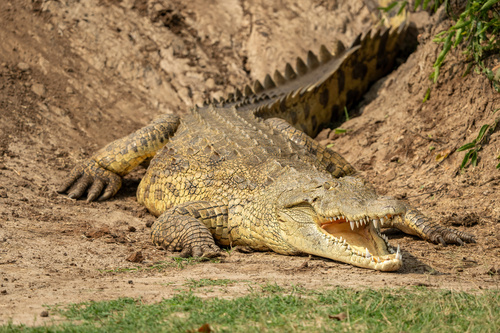
Nile Crocodile
Crocodylus niloticus
The undisputed king of the African waterways, the Nile Crocodile is a living relic of the dinosaur age. Witness the power and patience of this apex predator as it rules the rivers with ancient precision.
Quick Identification
Size
Length: 3.5 to 5 meters (11.5 to 16.5 feet); Weight: 225 to 750 kg (500 to 1,650 lbs)
Colors
Dark olive-green to grey-brown upper body; yellowish-white or cream underbelly; dark bands on the tail
Key Features
- Broad, heavy snout with the fourth lower tooth visible when the mouth is closed
- Tough, armored skin with bony plates called osteoderms along the back
- Powerful, muscular tail and webbed hind feet for aquatic propulsion
When You’ll See Them
Sightings on EverydayEarth
Aug 2, 2026
A family group of African Savanna Elephants, including adults and smaller calves, slowly walks away from the waterhole across the dry ground. In the foreground, a Nile Crocodile remains perfectly still on the bank near the edge of the water.
Aug 1, 2026
A bustling scene at the waterhole features several Waterbuck drinking at the edge. In the background, a small herd of Plains Zebras and a lone Common Wildebeest are visible on the dry ground. A pair of Warthogs trots along the opposite bank, while a large Nile Crocodile rests motionless on the shoreline to the left.
Jul 30, 2026
A Nile Crocodile lies motionless, basking on the sun-warmed mud at the edge of the water. As the camera zooms out, the vastness of the waterhole and the surrounding mountainous woodland terrain are revealed, with several birds visible in the far background near the water's edge.
Jul 29, 2026
A sunny morning at the waterhole reveals a diverse gathering of species. A large Nile Crocodile lies motionless on the far sandy bank, basking in the sun. In the foreground, several Egyptian Geese and White-faced Whistling-Ducks forage and rest along the shoreline, with some occasionally swimming into the rippling water. To the far left, a Grey Heron stands tall and still, watching for prey in the shallows.
Jul 27, 2026
A large Nile Crocodile is seen basking on the sunny shoreline of the waterhole. Nearby, a Blacksmith Lapwing hops through the dry brush, likely foraging for insects in the damp soil near the water's edge.
Jul 25, 2026
A herd of impala is seen grazing across the dry, open ground in the background. In the foreground, a large Nile crocodile lies perfectly still on the muddy bank of the waterhole, likely basking in the morning sun.
Behavior
The Nile Crocodile is a formidable apex predator known for its sophisticated social structure and patience. While they spend much of their day basking on riverbanks to regulate their body temperature, they are highly social animals that can be seen congregating in large numbers. Despite their size, they are remarkably stealthy, often remaining submerged with only their eyes and nostrils above the water line as they watch for potential prey.
These reptiles are famous for their maternal instincts, which is unusual for many reptiles. Females will guard their nests fiercely against predators and, once the eggs hatch, they gently carry their young to the water in their mouths. They communicate through a variety of vocalizations, including bellows, hisses, and growls, especially during the breeding season or when defending territory.
Interactions with humans are common in areas where residential zones border African waterways. While they generally avoid confrontation when basking, they are opportunistic and can become habituated to human activity. Their behavior is a mix of ancient instinct and calculated movement, making them one of the most successful predators in the natural world.
EverydayEarth exclusive
Camera Tips
When setting up a camera for a Nile Crocodile, safety is your absolute priority. These animals are powerful and potentially dangerous, so never place a camera by hand in an area where crocodiles are actively present without professional guidance. For the best shots, identify a 'basking spot'—typically a flat, sunny bank or a sandbar. Mount your camera to a sturdy tree or a heavy-duty post at a height of about 1.5 meters (5 feet) and angle it downward. This prevents the animal from bumping into the gear while ensuring you capture the full scale of its body as it exits the water.
Lighting is a major challenge with crocodile photography. Their dark, scaly skin can easily lose detail in bright midday sun or look like a dark mass at night. To combat this, set your camera to trigger during the golden hours of dawn and dusk. If your camera has adjustable exposure settings, underexpose slightly to preserve the texture of the scales. Use a fast trigger speed (0.5 seconds or less) and set the camera to take 3-5 photo bursts. While they move slowly on land, their transition from water to shore can be surprisingly quick, and you don't want to miss the 'emerging' shot.
For night monitoring, use a No-Glow or Black Flash camera. While crocodilians have excellent night vision, they are less likely to be spooked by non-visible infrared light. If you are monitoring a 'backyard' area bordering a canal or river, focus your lens on the mudline where footprints or 'slides' are visible. Do not use meat or lures to attract them, as this creates dangerous habituation; instead, rely on their natural habit of returning to the same basking spot every day. During the dry season, cameras placed near receding water holes will provide the highest frequency of captures as the population becomes more concentrated.
Similar Species
Species that look similar or are commonly confused with Nile Crocodile.
Frequently Asked Questions
Record Nile Crocodile at your habitat
Connect a camera to start building your own species record — AI identifies every visitor automatically.