Changing Forget-me-not
Myosotis discolor
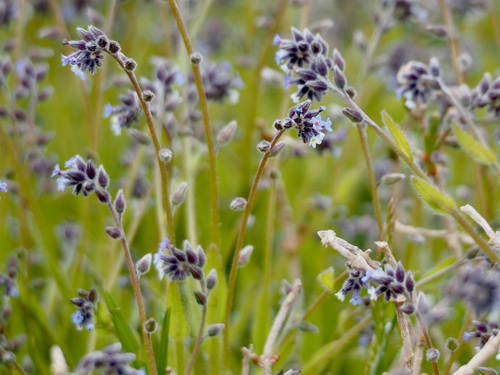
Witness nature's color-shifting magic in your own backyard. The Changing Forget-me-not is a delicate wildflower that transforms from cream-yellow to sapphire blue as it matures.
Quick Identification
Size
Height of 10–30 cm (4–12 inches); flower diameter of 2–3 mm (0.1 inches)
Colors
Flowers emerge creamy yellow, transition to pinkish-red, and mature into a deep sapphire blue
Key Features
- Flowers change color from yellow to blue as they age
- Stems and leaves covered in small, stiff hairs
- Tiny 5-petaled blossoms arranged in a coiled 'scorpion tail' cyme
- Narrow, lance-shaped leaves with a prominent central vein
When You’ll See Them
Geographic range
Where Does the Changing Forget-me-not Live?
Native to the temperate landscapes of Europe, the Changing Forget-me-not has successfully crossed the Atlantic to become a charming addition to the flora of both the eastern and western regions of North America. It is commonly found throughout the United Kingdom, France, and Germany, often flourishing in the gaps of suburban lawns and along sun-drenched roadsides. In its introduced range, it spans from the Pacific Northwest down to California and across the Atlantic coast from Newfoundland to the Carolinas.
Basemap © OpenStreetMap contributors
Behavior
Changing Forget-me-not is an annual or biennial plant known for its fascinating chromatic life cycle. As each tiny flower matures, the pH level within the petals shifts, causing the pigment to transition from a pale yellow or cream to a vibrant blue. This is not just for show; it serves as a signal to pollinators like hoverflies and small bees, indicating which flowers have already been pollinated and which still offer nectar rewards.
In a garden setting, this species behaves as an opportunistic 'weaver,' filling in gaps between larger perennials. It follows a rapid growth cycle, germinating in the fall or early spring, blooming profusely during the cooler months of late spring, and then setting seed and dying back as the summer heat intensifies. It is a prolific self-seeder, often appearing in the same spot year after year without human intervention.
EverydayEarth exclusive
Camera Tips
Capturing the Changing Forget-me-not requires a focus on macro photography. Because these plants are small and grow low to the ground, you should mount your camera on a ground-level spike or a very low tripod. Aim for a 45-degree downward angle to capture the 'scorpion tail' curve of the flower head, which displays the color transition from the bottom (older, blue flowers) to the top (younger, yellow buds).
The unique value of using an AI-powered camera with this species is time-lapse. Set your camera to take a high-resolution still every 2–4 hours over the course of a week during the peak blooming season in May. When stitched together, you can witness the incredible 'color-changing' behavior as the yellow buds gradually blush into pink and finally settle into blue across the entire patch.
Since the flowers are tiny, focus-breathing or autofocus hunting can be an issue. If your camera allows, set a manual focal point on a cluster of buds. To get the best color accuracy, avoid direct, harsh midday sun; instead, utilize the soft light of dawn or dusk, or capture them on a bright but overcast day to prevent the delicate blue pigments from looking washed out in the footage.
Similar Species
Species that look similar or are commonly confused with Changing Forget-me-not.
Field Forget-me-not
Flowers are consistently blue with a tiny yellow center, rather than starting entirely yellow and turning blue.
Wood Forget-me-not
Larger flowers (up to 10mm) and prefers shaded, damp woodlands rather than dry, disturbed ground.
Early Forget-me-not
A much smaller plant that usually stays under 15cm and has darker blue flowers that do not show the same cream-to-blue transition.
Frequently Asked Questions
Record Changing Forget-me-not at your habitat
Connect a camera to start building your own species record — AI identifies every visitor automatically.