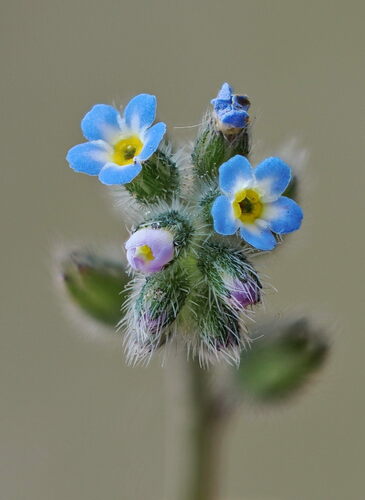
Early Forget-me-not
Myosotis ramosissima
One of the first splashes of color in the spring, the Early Forget-me-not is a tiny but resilient wildflower. Its sky-blue blooms and hairy stems are a classic sign of the changing seasons in dry meadows and gardens.
Quick Identification
Size
5-30 cm (2-12 inches) tall; flowers 1-3 mm (0.04-0.12 inches) wide
Colors
Bright sky-blue petals with a yellow 'eye' at the center; grayish-green stems and foliage
Key Features
- Tiny five-petaled blue flowers with yellow centers
- Stems and leaves covered in dense, short hairs
- Coiled flower spikes (cymes) that unroll as they bloom
- Hairy calyx with hooked tips at the base of the flower
When You’ll See Them
Geographic range
Where Does the Early Forget-me-not Live?
Native to Europe, North Africa, and Western Asia, the Early Forget-me-not is a common sight across the temperate Palearctic region. Its core range spans from the United Kingdom and Scandinavia southward to the Mediterranean coast and eastward through the Middle East into parts of Central Asia. While primarily a resident of the Old World, localized populations have been introduced to North America, where it occasionally appears in dry, disturbed soils.
Basemap © OpenStreetMap contributors
Behavior
The Early Forget-me-not is a hardy annual wildflower that marks the arrival of spring. It completes its life cycle quickly, germinating in the autumn or early spring and reaching full bloom while many other plants are still dormant. Its growth is focused on rapid reproduction, sending up thin, branched stems that support clusters of minute flowers.
The plant exhibits a 'scorpion-tail' growth pattern, where the flower head is initially tightly coiled and gradually straightens as each bud matures and opens. This ensures a staggered blooming period that maximizes the chances of pollination by early-emerging insects like small hoverflies and solitary bees. Once the seeds have set in early summer, the plant typically withers and disappears, leaving its seeds to wait for the next growing season.
EverydayEarth exclusive
Camera Tips
To capture the Early Forget-me-not on camera, you must think small and low. Because this plant rarely exceeds a few inches in height, place your camera on a ground-level mount or a sturdy beanbag. Angle the lens horizontally or slightly upward to catch the blue of the petals against the sky, which helps the AI identification software distinguish the tiny flowers from the surrounding green foliage.
Lighting is the most important factor for this species. The flowers are phototropic and most vibrant during the middle of the day. Set your camera to capture high-resolution stills or time-lapse sequences between late morning and mid-afternoon. If your camera has a 'macro' mode or a lens with a short minimum focus distance, position it about 8-12 inches from a cluster of blooms for the best detail.
Because these plants favor sandy, open soil, look for patches where the grass is thin or near the edges of gravel paths in your yard. Avoid placing the camera in deep shade, as the flowers may remain partially closed. A steady, windless day is ideal; even a light breeze can cause the thin stems to blur in photos. Using a high shutter speed or 'Sports Mode' can help freeze the motion of the stems if it is a windy day.
Similar Species
Species that look similar or are commonly confused with Early Forget-me-not.
Frequently Asked Questions
Record Early Forget-me-not at your habitat
Connect a camera to start building your own species record — AI identifies every visitor automatically.