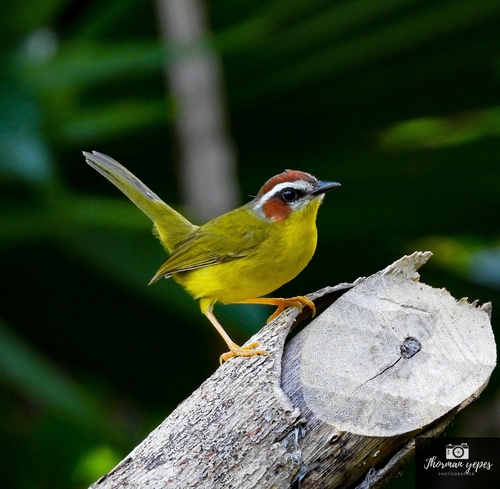
Chestnut-capped Warbler
Basileuterus delattrii
A restless sprite of the Central American thickets, the Chestnut-capped Warbler stands out with its fiery facial markings and vibrant yellow plumage. A year-round resident of coffee farms and forest edges, this charismatic bird is a favorite for backyard observers in the Neotropics.
Quick Identification
Size
13 cm (5.1 in) in length; weighs approximately 11-13 g (0.4-0.45 oz)
Colors
Bright chestnut crown and ear patches; olive-green upperparts; vibrant yellow throat and belly; distinctive white stripe above the eye
Key Features
- Solid chestnut crown and cheek patches
- Vibrant yellow underparts from throat to vent
- Bold white supercilium (eyebrow) contrast
- Olive-colored back and wings
When You’ll See Them
Geographic range
Where Does the Chestnut-capped Warbler Live?
The Chestnut-capped Warbler is a jewel of the Neotropics, native to the mountain slopes and foothills of Central and South America. Its range begins in the highlands of Guatemala and extends through El Salvador, Honduras, Nicaragua, and Costa Rica, reaching into the Darien Gap of Panama. Beyond the isthmus, it thrives in the northern Andean foothills of Colombia and coastal mountains of Venezuela, favoring mid-elevation environments over the humid lowlands.
Basemap © OpenStreetMap contributors
Behavior
These warblers exhibit a charming habit of cocking their tails upward and flicking their wings while foraging, which can help observers spot them in the dim light of the forest floor. While they are generally shy and prefer the safety of thick cover, they are curious birds and may occasionally venture into more open garden areas if there is a reliable water source or a particularly insect-rich patch of vegetation.
EverydayEarth exclusive
Camera Tips
To capture the best footage of a Chestnut-capped Warbler, position your camera at a low height, ideally between 1 and 3 feet off the ground. These birds are understory specialists and rarely spend time in the high canopy, preferring to stay within the safety of dense shrubs and tall grasses. Angling the camera slightly upward can help capture the bird's bright yellow throat and the distinctive chestnut 'cap' that gives the species its name.
Because these warblers are insectivores, traditional seed feeders won't attract them. Instead, focus your camera on a water feature. A birdbath with a solar-powered 'wiggler' or a small dripping mechanism is incredibly effective, as the sound and movement of water are irresistible to them. Place the water feature near the edge of a thicket so the bird feels safe enough to emerge for a bath or a drink.
Use a camera with a very fast trigger speed or high-speed video capabilities. These birds are extremely fast and rarely sit still for more than a second or two; a slow camera will likely result in a gallery of blurry yellow feathers. Setting your camera to 'Burst Mode' or 60fps video will give you the best chance of catching a clear, identifiable frame of their facial markings.
In terms of timing, the first few hours after dawn are the 'golden window.' These warblers are most vocal and active during this period as they defend their territory and hunt for insects that are still sluggish from the cool night temperatures. If you live in an area with coffee plantations or diverse backyard shrubbery, look for areas with 'layered' vegetation to place your gear.
Similar Species
Species that look similar or are commonly confused with Chestnut-capped Warbler.
Frequently Asked Questions
Record Chestnut-capped Warbler at your habitat
Connect a camera to start building your own species record — AI identifies every visitor automatically.