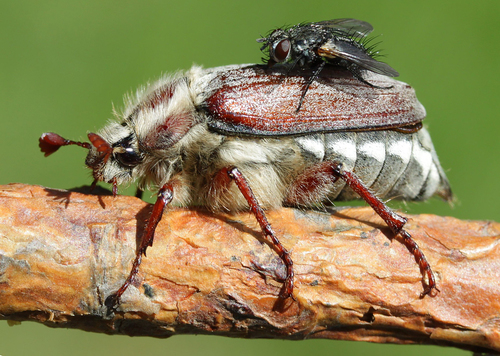
Chestnut cockchafer
Melolontha hippocastani
A woodland relative of the famous Maybug, the Chestnut cockchafer is a herald of spring known for its rich reddish-brown wing cases and impressive fan-like antennae.
Quick Identification
Size
20–25 mm (0.8–1.0 inches) in length
Colors
Chestnut-brown elytra (wing cases) with dark margins, black or dark brown pronotum, and distinctive white triangular spots along the sides of the abdomen.
Key Features
- Reddish-brown 'chestnut' wing cases
- Short, narrow, and slightly constricted pygidium (tail-end)
- Large fan-like antennae with 6-7 leaves
- Loud, heavy buzzing sound during flight
When You’ll See Them
Geographic range
Where Does the Chestnut cockchafer Live?
The Chestnut cockchafer is native to the temperate regions of Europe and Northern Asia. Its core population density is found in Central and Eastern Europe, particularly in countries like Germany, Poland, and Russia, where it favors the sandy soils of forested regions. While it shares much of its territory with the Common cockchafer, it extends further north and east into the Siberian taiga, though it is generally absent from the British Isles and the southernmost Mediterranean peninsulas.
Basemap © OpenStreetMap contributors
Behavior
The Chestnut cockchafer is famous for its dramatic spring emergence, appearing in massive numbers during 'cockchafer years.' These beetles spend the vast majority of their lives—usually three to four years—underground as larvae (white grubs), feeding on roots. When they finally emerge as adults in May, they take to the air with a heavy, clumsy buzzing flight that can be quite startling to the uninitiated.
Adults are primarily active at twilight, flying from the ground toward the silhouettes of tall trees to feed and mate. While they can be seen as pests in forestry due to their appetite for leaves, they are a vital food source for many backyard visitors, including owls, bats, and hedgehogs. In the garden, they are often seen bumping into windows or hovering around outdoor lights.
EverydayEarth exclusive
Camera Tips
To capture the Chestnut cockchafer on camera, you should focus your efforts during the 'May flight' period. Because these beetles are most active at dusk, setting your AI-powered camera to its high-sensitivity night mode or ensuring you have a good infrared (IR) flash is essential. They are highly attracted to artificial light sources, so placing your camera near a porch light or a white-lit sheet can act as a natural lure.
Since these beetles are relatively small compared to mammals, use a camera with a good macro focus capability or place the camera within 1–2 feet of a branch where they are likely to land. Focus on the edges of deciduous trees like oaks or birches. If your camera allows for high-speed triggers, you might capture their spectacular, if slightly uncoordinated, takeoff or landing sequences.
For the best results, look for 'emergence holes' in sandy soil during late April. Position your camera at ground level facing these holes to catch the adults as they first crawl out of the earth. Avoid using heavy pesticides in the area, as this will prevent them from appearing in your frame.
Similar Species
Species that look similar or are commonly confused with Chestnut cockchafer.
Frequently Asked Questions
Record Chestnut cockchafer at your habitat
Connect a camera to start building your own species record — AI identifies every visitor automatically.