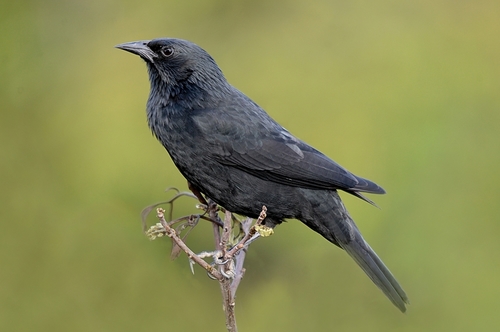
Chopí Blackbird
Gnorimopsar chopi
With its soulful whistles and shimmering jet-black plumage, the Chopí Blackbird is the musical heart of the South American savanna. A master mimic and social resident, this intelligent songbird is a frequent visitor to backyard gardens and open woodlands alike.
Quick Identification
Size
Length 23-25 cm (9-10 inches); weight 60-90 g (2.1-3.2 oz)
Colors
Entirely coal-black plumage with a silky bluish gloss; black bill, legs, and eyes
Key Features
- Uniform glossy black plumage
- Stout black bill with a distinct groove on the lower mandible
- Squared-off tail tip
- Melodious, loud whistling song
- Often seen in small, noisy groups
When You’ll See Them
Geographic range
Where Does the Chopí Blackbird Live?
The Chopí Blackbird is a quintessential South American resident, found across a vast territory in the continent's interior and eastern regions. Its heartland spans the lush Cerrado and Atlantic Forest regions of Brazil, extending southward through the humid Chaco of Paraguay and northern Argentina, and into the rolling grasslands of Uruguay. It also occupies the eastern Andean foothills of Bolivia and parts of southeastern Peru, where it thrives in open landscapes.
Basemap © OpenStreetMap contributors
Behavior
The Chopí Blackbird is one of South America's most charismatic vocalists, celebrated for a complex song that includes loud whistles, flute-like notes, and metallic trills. They are highly social birds, often seen in small flocks or pairs, moving through open woodlands and agricultural fields with a distinctive, jerky hopping motion. Unlike many of their relatives in the Icterid family, they are quite comfortable around human settlements and frequently visit suburban gardens and urban parks.
These birds are remarkably intelligent and are renowned for their mimicry, often incorporating the calls of other bird species or even ambient mechanical noises into their singing. During the breeding season, they are versatile cavity nesters, utilizing hollow tree trunks, old woodpecker holes, or even the abandoned mud nests of Rufous Horneros. They are bold and territorial, often seen chasing away larger birds or predators from their nesting sites.
EverydayEarth exclusive
Camera Tips
To capture the shimmering beauty of the Chopí Blackbird, place your AI camera near a bird bath or a low-lying water feature. These birds are frequent and enthusiastic bathers, and they are most likely to pause for a clear, focused photo when they are drinking or preening. Position the camera at a height of 1 to 2 feet, angled slightly upward if the water source is on a pedestal, to capture the iridescent blue sheen of their feathers against the sunlight.
Feeding stations are also highly effective for this species. Offer a mix of chopped fruit like papaya or bananas, or provide a ground-level platform with sunflower seeds and cracked corn. Because the bird is entirely black, lighting is your biggest challenge; try to orient your camera so the morning sun illuminates the bird from the front. This prevents the bird from appearing as a mere silhouette and allows the camera's sensor to pick up eye detail and bill texture.
For the best results, use a high-sensitivity motion trigger. Chopí Blackbirds are active and move with quick, sudden hops that can result in motion blur on slower cameras. Capturing them during the early morning (6 AM to 9 AM) is ideal, as this is their peak social time when they are most likely to congregate in groups. If your camera supports video with sound, you'll be able to record their spectacular whistling songs, which are a highlight of any backyard wildlife collection.
Similar Species
Species that look similar or are commonly confused with Chopí Blackbird.
Shiny Cowbird
Smaller with a thinner, shorter bill and a more purple-tinted iridescence compared to the Chopí's blue gloss.
Austral Blackbird
Found further south in Patagonia and Chile; it lacks the distinct mandible groove of the Chopí.
Screaming Cowbird
Very similar in color but has a shorter, more conical finch-like bill and lacks the Chopí's melodious whistling song.
Frequently Asked Questions
Record Chopí Blackbird at your habitat
Connect a camera to start building your own species record — AI identifies every visitor automatically.