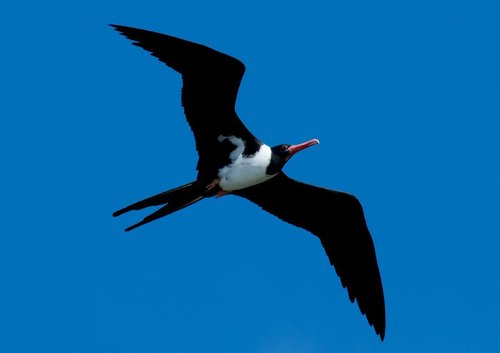
Christmas Frigatebird
Fregata andrewsi
The rarest frigatebird on Earth, this magnificent aerialist is a master of the Indian Ocean skies. With its massive wingspan and the male's iconic red throat pouch, it is the ultimate symbol of Christmas Island's unique biodiversity.
Quick Identification
Size
Length: 89–100 cm (35–39 in); Wingspan: 205–230 cm (81–91 in); Weight: 1,200–1,550 g (2.6–3.4 lb)
Colors
Glossy black plumage; males have a white belly patch and a red gular pouch; females have a white breast, belly, and collar
Key Features
- Massive inflatable red throat pouch (males)
- White belly patch contrasting with black wings
- Deeply forked 'scissor' tail
- Extremely long, narrow angular wings
When You’ll See Them
Geographic range
Where Does the Christmas Frigatebird Live?
The Christmas Frigatebird is an incredibly rare seabird native to the eastern Indian Ocean, with its only known breeding grounds located on the Australian territory of Christmas Island. While they are anchored to this single island for nesting, their foraging range is vast, extending across the waters of Indonesia, Malaysia, Thailand, and occasionally reaching the northern coast of Australia. These aerial wanderers are most frequently spotted over the Sunda Shelf and the deep blue waters surrounding the Indo-Malay Archipelago.
Basemap © OpenStreetMap contributors
Behavior
Often called the 'pirates of the sky,' Christmas Frigatebirds are masters of aerial maneuverability. Because their feathers are not waterproof, they never land on the water; instead, they spend most of their lives in the air, even sleeping while soaring on thermal currents. They are well-known for kleptoparasitism, a behavior where they chase other seabirds like boobies and tropicbirds, harassing them until they disgorge their catch, which the frigatebird then snatches mid-air.
On land, these birds are clumsy due to their short legs and small feet, which are adapted for perching rather than walking. During the breeding season, males congregate in the forest canopy of Christmas Island to perform elaborate displays. They inflate their massive, heart-shaped red throat pouches to attract females flying overhead, vibrating their wings and making drumming sounds to claim the best nesting sites in the tall jungle trees.
EverydayEarth exclusive
Camera Tips
Capturing the Christmas Frigatebird on a trail camera is a unique challenge because they are almost exclusively aerial. To see them at eye level, you must place cameras near their nesting sites in the tall forest canopies of Christmas Island. Mounting a camera on a high branch or using a telescoping pole at the edge of a coastal terrace is the most effective method. Ensure the camera is angled slightly downward toward the canopy to capture the birds as they land or take off from their nests.
Because these birds are not attracted to traditional feeders, your 'bait' is the location. Focus on gaps in the tree canopy that serve as 'flight paths' where the birds have enough clearance for their two-meter wingspans. Setting your camera to a very high shutter speed or using a 'Burst Mode' is critical; these birds move with incredible speed and agility, and standard settings often result in a blur of black feathers. If your camera supports it, 4K video at 60fps is the best way to document their complex social interactions and pouch displays.
Pay close attention to lighting. In the dense tropical forest, the contrast between the dark birds and the bright sky can be extreme. Position your camera so it is not pointing directly into the sun during the morning or afternoon peak activity times. The best footage is usually captured during the golden hour before sunset, when the low-angled light illuminates the male's vibrant red pouch and the iridescent sheen on their black feathers.
Similar Species
Species that look similar or are commonly confused with Christmas Frigatebird.
Frequently Asked Questions
Record Christmas Frigatebird at your habitat
Connect a camera to start building your own species record — AI identifies every visitor automatically.