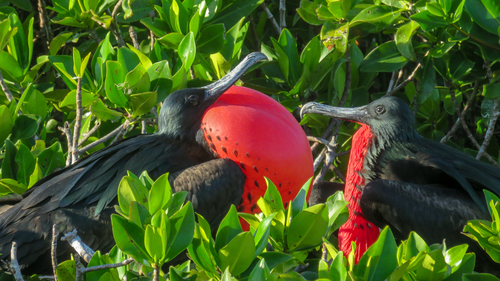
Great Frigatebird
Fregata minor
The ultimate 'pirate of the sky,' the Great Frigatebird is a marvel of evolution, boasting a wingspan larger than a king-sized bed and the ability to fly for months without ever touching the ground.
Quick Identification
Size
Length of 33–41 in (85–105 cm); wingspan of 81–91 in (205–230 cm); weight of 2.2–3.5 lb (1.0–1.6 kg)
Colors
Males are iridescent black with a scarlet throat pouch; females are black with a white breast and throat; juveniles have white heads.
Key Features
- Deeply forked 'scissor' tail used for aerial steering
- Long, hooked grey bill for snatching prey
- Enormous wingspan relative to a light, slender body
- Male inflatable red gular sac
When You’ll See Them
Geographic range
Where Does the Great Frigatebird Live?
The Great Frigatebird is a true citizen of the tropical oceans, found across the warm waters of the Pacific and Indian Oceans, with a smaller, isolated presence in the South Atlantic. Their range is anchored by major nesting colonies in the Galápagos Islands, Hawaii, the Seychelles, and Mauritius, but they are known to wander thousands of miles from land between breeding seasons. Because they spend the vast majority of their lives on the wing, they can be spotted anywhere within the tropical belt where warm currents bring prey to the surface.
Basemap © OpenStreetMap contributors
Behavior
The Great Frigatebird is an absolute master of the air, capable of staying aloft for weeks at a time by hitching rides on thermal updrafts. Interestingly, despite being a seabird, they lack waterproof feathers and have very small feet, meaning they cannot land on the water or swim. If they become waterlogged, they risk drowning, which has led them to evolve incredible aerial precision to snatch food from the surface without ever touching the waves.
These birds are famously known as 'kleptoparasites' or 'pirates of the sky.' They frequently harass other seabirds, like boobies and tropicbirds, in mid-air, chasing and nipping at them until the victim disgorges its recent meal, which the frigatebird then catches before it hits the water. Socially, they are colonial nesters, and during the breeding season, males gather in groups to display their vibrant, balloon-like red throat pouches to passing females.
EverydayEarth exclusive
Camera Tips
Capturing the Great Frigatebird on a trail camera requires a coastal or island setup, as these birds rarely venture far inland. If you live on a tropical coast or island, place your camera on a high vantage point like a cliff edge, balcony, or a sturdy mangrove branch where they are known to roost. Because they are almost always in motion, set your camera to 'Burst Mode' or high-speed video (60fps or higher) to freeze their incredible aerial maneuvers and forked tail movements.
Wide-angle lenses are your best friend when filming frigatebirds. Their wingspan is massive, often exceeding seven feet, and they can easily fly out of a narrow frame before the sensor triggers. Aim the camera slightly upward toward the sky or along the coastline to catch them as they patrol for fish. Avoid using traditional baits, as these birds respond to movement on the water surface; instead, placing a camera near a known colony of other seabirds (like boobies) can capture the 'pirate' behavior as frigatebirds swoop in to steal food.
For the best lighting, capture footage during the 'golden hours' of early morning or late afternoon. The low sun angle beautifully illuminates the iridescent green and purple sheen on the male's black feathers and makes the red throat pouch pop against the blue sky. If your camera allows for shutter speed adjustments, keep it fast (1/1000s or more) to avoid motion blur during their high-speed aerial chases.
Similar Species
Species that look similar or are commonly confused with Great Frigatebird.
Frequently Asked Questions
Record Great Frigatebird at your habitat
Connect a camera to start building your own species record — AI identifies every visitor automatically.