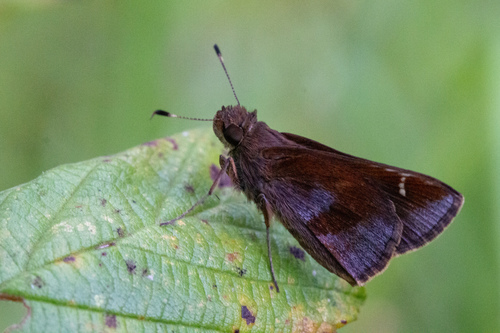
Clouded Skipper
Lerema accius
A master of camouflage with a subtle violet sheen, the Clouded Skipper is a frequent guest in southern gardens. Look for its rapid, darting flight and its preference for sunny, grassy borders.
Quick Identification
Size
Wingspan of 3.2 to 4.5 cm (1.25 to 1.75 inches)
Colors
Deep chocolate brown to blackish-brown wings; hindwing underside features a distinct violet-gray or 'clouded' patch; small white translucent spots on the forewings.
Key Features
- Dark, chocolate-brown wings with a purplish or violet-gray 'clouded' patch on the underside
- Pointed forewings featuring 2-3 small, clear white spots
- Distinctive 'jet plane' resting posture with hindwings flat and forewings angled upward
When You’ll See Them
Geographic range
Where Does the Clouded Skipper Live?
This resilient skipper is native to the Americas, stretching from the southeastern United States across the Gulf Coast and down into the Neotropics. Its core range begins in Georgia and Florida, extending west to Texas and south through the lush landscapes of Mexico and Central America, finally reaching its southern limits in Colombia and Venezuela. While primarily a resident of warmer climates, it occasionally wanders further north along the Atlantic coast during the peak of summer, though it cannot survive harsh winters.
Basemap © OpenStreetMap contributors
Behavior
The Clouded Skipper is a common yet often overlooked visitor to southern gardens, known for its rapid, darting flight pattern characteristic of the Hesperiidae family. Unlike many showier butterflies, these skippers prefer to stay low to the ground, frequently weaving through tall grasses or pausing on low-lying flowers. They are relatively solitary but can be found in high concentrations where nectar sources are abundant, particularly in late summer when populations peak.
These insects are highly sensitive to movement and will 'skip' away at the slightest disturbance. When feeding or resting, they exhibit a unique posture, holding their forewings at a 45-degree angle while keeping their hindwings horizontal. This behavior, combined with their dark coloration, helps them blend into shadows and avoid avian predators. They are particularly fond of backyard lawns that utilize St. Augustine grass, which serves as a primary host plant for their larvae.
EverydayEarth exclusive
Camera Tips
To capture the Clouded Skipper on your backyard AI camera, focus on 'macro-zones' within your garden. Because these butterflies are small and fly low, place your camera just 12 to 18 inches off the ground. Aiming the lens at a cluster of nectar-rich flowers like Lantana or Zinnia will yield the best results. A side-angle view is preferable to a top-down one, as it allows the camera to capture the distinctive violet-gray 'clouding' on the underside of the wings, which is essential for accurate identification.
Lighting is your best friend when filming skippers. Position your camera so the sun is behind it (facing north or south depending on the time of day) to illuminate the subtle purple sheen on their dark wings. If your camera allows for focal adjustments, set a narrow field of view or a close-up focus mode to prevent the AI from mistaking the butterfly for a moving leaf. Avoid high-traffic areas where pets might trigger the camera unnecessarily, as these butterflies are easily spooked by sudden vibrations.
Timing is critical for these sun-loving insects. They are most active during the warmest parts of the day, typically between late morning and mid-afternoon. If you live in a region with St. Augustine grass, placing a camera near the edge of the lawn where the grass meets a flower bed is a 'hot spot' for activity. During late summer and early autumn, you will likely see a significant spike in sightings, making this the ideal window to set up your gear for the best possible footage.
Similar Species
Species that look similar or are commonly confused with Clouded Skipper.
Frequently Asked Questions
Record Clouded Skipper at your habitat
Connect a camera to start building your own species record — AI identifies every visitor automatically.