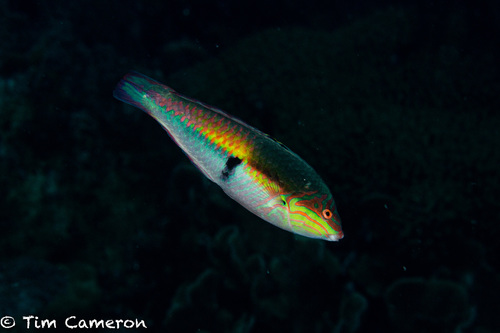
Clown Wrasse
Halichoeres maculipinna
A vibrant jewel of the Caribbean, the Clown Wrasse is a master of transformation that brings energetic color to the Atlantic's coral reefs. From its striking 'clown' markings to its fascinating ability to change gender, this active fish is a favorite for underwater observers.
Quick Identification
Size
12–18 cm (4.7–7 inches) in length; weight typically under 150g (5.3 oz)
Colors
Juveniles and females are white with a broad black mid-body stripe and red spots on the head; terminal males are vibrant green, blue, and yellow with a large black blotch on the side.
Key Features
- Broad black horizontal stripe along the mid-body
- Red spots or lines on the top of the head and dorsal fin
- Cigar-shaped, streamlined body
- Terminal males feature a vivid 'clown-like' pattern of green and yellow
When You’ll See Them
Geographic range
Where Does the Clown Wrasse Live?
The Clown Wrasse is a quintessential resident of the Western Atlantic Ocean, with a native range extending from the warm coastal waters of North Carolina and Bermuda down through the Florida Keys. Its population is most dense throughout the Caribbean Sea and the Gulf of Mexico, reaching as far south as the coast of Brazil. This species is strictly marine and stays within the tropical and subtropical thermal bands where coral reef health is most robust.
Basemap © OpenStreetMap contributors
Behavior
The Clown Wrasse is a hyperactive diurnal swimmer, spending its entire day darting through reef structures and seagrass in search of food. They are highly social but maintain a strict hierarchy; they are protogynous hermaphrodites, meaning they start life as females and the most dominant individuals eventually transition into brightly colored terminal males to lead a harem.
These fish are famously curious and bold. They are known to follow larger foraging animals, such as goatfish or even human divers, to snatch up small invertebrates that are stirred up from the sand. At sunset, they exhibit a unique survival strategy: they dive into the sandy substrate and bury themselves completely to sleep, protecting themselves from nocturnal predators like eels and snappers.
EverydayEarth exclusive
Camera Tips
Capturing the Clown Wrasse on an underwater AI-powered camera requires placing your equipment in 'transition zones'—the areas where a coral reef or rocky outcrop meets a sandy floor. These fish frequently patrol these boundaries while hunting for hidden invertebrates. Position your camera housing at a depth of 3 to 10 feet for the best natural light, angling the lens slightly toward the reef structure to catch the fish as they emerge from cover.
To attract a Clown Wrasse to your lens, you can simulate a natural feeding event by gently 'fanning' a small area of sand to expose potential prey, or by using a weighted mesh bait bag containing crushed shellfish. Their inquisitive nature means they will often be the first species to investigate any disturbance in the sediment. Because they are fast swimmers, ensure your camera is set to a high shutter speed or a frame rate of at least 60fps to capture their iridescent scales without motion blur.
Early morning and late afternoon provide the most dramatic lighting for underwater photography, but for the most accurate AI identification, mid-day sun is best as it penetrates deeper into the water column, revealing the true green and yellow hues of the terminal males. If your camera is near a dock or seawall, look for areas with high algae or barnacle growth, as these are the preferred 'backyard' habitats for juveniles and females.
Similar Species
Species that look similar or are commonly confused with Clown Wrasse.
Frequently Asked Questions
Record Clown Wrasse at your habitat
Connect a camera to start building your own species record — AI identifies every visitor automatically.