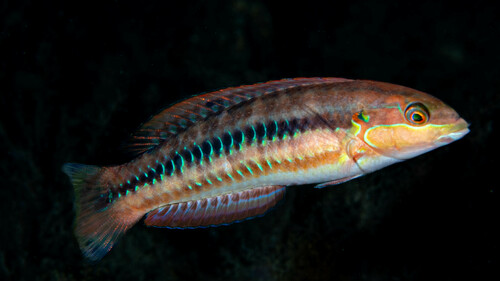
Slippery Dick
Halichoeres bivittatus
The Slippery Dick is the reef's most energetic explorer, known for its bold personality and stunning color transformations. Whether darting through seagrass or following divers, this agile wrasse is a master of the shallow Atlantic waters.
Quick Identification
Size
Typically 7 to 10 inches (18 to 25 cm), though large males can reach up to 14 inches (35 cm).
Colors
Juveniles and females (initial phase) are white with two distinct dark horizontal stripes. Mature males (terminal phase) transform into a vibrant green or blue-green with pink, purple, and yellow highlights.
Key Features
- Two dark horizontal stripes running the length of the body
- Small dark spot at the base of the dorsal fin and tail
- Elongated, cigar-shaped body
- Protractile mouth with small canine teeth
When You’ll See Them
Sightings on EverydayEarth
Jun 29, 2026
The scene shows a vibrant coral reef community. Several Bluehead Wrasse in their bright yellow initial phase swim actively around large sea fans. A terminal phase Bluehead Wrasse, characterized by its distinct blue head and banded body, drifts through the upper water column. A Slippery Dick wrasse is also seen darting between the coral structures, identified by its characteristic lateral stripes.
Jun 26, 2026
A bright yellow Caribbean Bluehead Wrasse swims through the sea fans, followed closely by a Slippery Dick wrasse moving across the foreground reef floor.
Behavior
The Slippery Dick is a highly active and inquisitive member of the wrasse family. Known for its constant movement, it is frequently seen darting between coral heads and over sandy patches in search of food. They are remarkably bold and are often the first fish to arrive when the seabed is disturbed, eagerly scavenging for any exposed invertebrates. Their name comes from their incredible agility and a thick mucus coating that makes them nearly impossible to grasp by hand.
Socially, they exhibit a fascinating life cycle called protogynous hermaphroditism, where individuals can change sex from female to male. They are primarily solitary hunters but will congregate around food sources. At night, they exhibit a unique survival strategy: they dive head-first into the sand and bury themselves completely to sleep, protecting themselves from nocturnal predators.
EverydayEarth exclusive
Camera Tips
Capturing the Slippery Dick on an AI-powered camera requires an underwater setup, such as a waterproof housing for a trail cam or a dedicated reef-monitoring camera. For those with coastal 'backyards' like docks or seawalls, the best results come from placing the camera 2 to 5 feet below the low-tide line. Angle the lens slightly downward toward a sandy patch adjacent to a rocky structure or reef; this 'edge' habitat is where the fish spend most of their time foraging.
Because they are highly visual and curious, you don't always need complex lures, but 'chumming' the area can create an incredible action sequence for your AI trigger. A perforated PVC pipe filled with crushed shrimp or sea urchins will act as a scent magnet. Position the bait station about 18 inches in front of the lens. The Slippery Dick's rapid, darting swimming style can sometimes blur images, so use a high shutter speed or a camera setting with a high frame rate (60fps) if your device allows.
Lighting is the most critical factor for showcasing their iridescent colors. Mid-day sun (between 10 AM and 2 PM) provides the best natural light penetration in shallow water, turning their subtle pinks and greens into vibrant highlights. If your camera is under a dock, consider a small, wide-angle LED submerged light to prevent the 'silhouette effect.' Be sure to clean the lens housing every few days, as algae and barnacles grow quickly in the warm, shallow waters where these fish thrive.
In terms of AI settings, increase the sensitivity for 'motion' triggers. These fish are relatively small and fast, so a low-sensitivity setting might miss the initial approach. If your camera software allows for 'burst mode,' set it to take 3-5 photos per trigger to ensure at least one shot captures the fish in profile, which is essential for identifying the characteristic horizontal stripes of this species.
Similar Species
Species that look similar or are commonly confused with Slippery Dick.
Clown Wrasse
The Clown Wrasse lacks the two distinct full-length horizontal stripes and often features a dark 'ear' spot and more complex facial markings.
Yellowhead Wrasse
Adult Yellowhead Wrasses have a bright yellow head and a dark vertical bar behind the gill, unlike the horizontal stripes of the Slippery Dick.
Frequently Asked Questions
Record Slippery Dick at your habitat
Connect a camera to start building your own species record — AI identifies every visitor automatically.