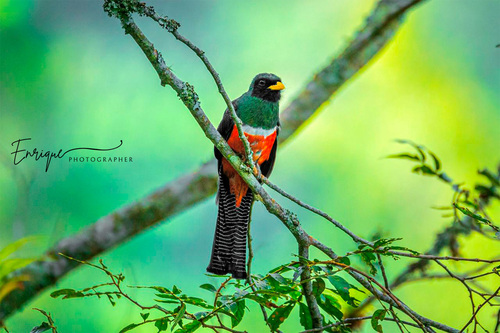
Collared Trogon
Trogon collaris
With its brilliant crimson belly and shimmering green plumage, the Collared Trogon is a jewel of the tropical forest. This patient hunter brings an exotic flair to the mid-story canopy, sitting motionless before striking with lightning speed.
Quick Identification
Size
25–29 cm (9.8–11.4 in) long; wingspan approx. 35-40 cm (14-16 in); weight 41–70 g (1.4–2.5 oz)
Colors
Males have metallic green upperparts, a bright red belly, and a narrow white chest band. Females are olive-brown with a similar red belly.
Key Features
- Bright red belly with a narrow white breast band
- Metallic green or olive-brown upperparts
- Finely barred black-and-white undertail feathers
- Short, pale yellow bill with a black facial mask
When You’ll See Them
Geographic range
Where Does the Collared Trogon Live?
The Collared Trogon is a hallmark species of the Neotropics, with a native range that begins in the tropical forests of central Mexico. It inhabits nearly every country in Central America and extends deep into the northern half of South America, including the Amazon Basin and the Atlantic Forest. You can find them across a massive geographic span from the Andean foothills of Colombia and Ecuador to the coastal forests of Brazil.
Basemap © OpenStreetMap contributors
Behavior
Collared Trogons are known for their patient, almost stoic behavior. They are often observed sitting perfectly still on mid-story branches for long stretches of time, occasionally tilting their heads to scan for prey. This 'sit-and-wait' strategy makes them masters of camouflage despite their bright colors, as they blend into the dappled light of the forest canopy.
When they hunt, they exhibit a specialized behavior called hover-gleaning. Instead of landing to eat, they launch into a short, acrobatic flight to pluck a fruit or snatch an insect directly from a leaf before returning to a nearby perch. They are generally solitary or found in pairs and are more often heard than seen, making a repetitive, hollow series of whistling notes that echo through the humid woods.
EverydayEarth exclusive
Camera Tips
To successfully capture a Collared Trogon on a backyard or trail camera, focus on the 'mid-story'—the layer of vegetation between the ground and the high canopy. Mount your camera between 5 and 10 feet high, preferably on a tree trunk overlooking a relatively clear horizontal branch. Trogons love to use these open branches as 'launch pads' for their hunting sallies, and they will often return to the same perch repeatedly if the hunting is good.
While traditional bird feeders rarely attract trogons, you can lure them by placing your camera near native fruiting trees, particularly those in the Lauraceae family (wild avocados) or shrubs with small, fleshy berries. If you live in an area where they are active, look for dead tree stumps; Collared Trogons are cavity nesters and may investigate rotting wood or old woodpecker holes during the breeding season from March to July.
Settings are crucial for this species. Because they often sit in shaded, low-light environments, ensure your camera has a high-quality sensor that handles low light well without excessive grain. Use a fast trigger speed to catch them in motion, as their flight to grab fruit is incredibly quick. A 'no-glow' infrared flash is recommended for early morning or late afternoon shots to avoid startling the bird, as they are naturally shy and easily spooked by sudden light or movement.
Similar Species
Species that look similar or are commonly confused with Collared Trogon.
Frequently Asked Questions
Record Collared Trogon at your habitat
Connect a camera to start building your own species record — AI identifies every visitor automatically.