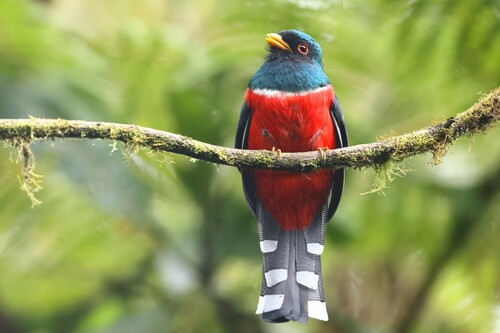
Masked Trogon
Trogon personatus
A mist-dwelling marvel of the Andes, the Masked Trogon captivates with its brilliant crimson plumage and iconic black facial mask. This high-altitude resident is a master of the 'sit-and-wait' hunt in South America's most beautiful cloud forests.
Quick Identification
Size
25–27 cm (9.8–10.6 inches) in length; weighs approximately 50–60g (1.8–2.1 oz)
Colors
Males have iridescent green heads and backs, a bright red belly, and a black face; females are brown where males are green.
Key Features
- Distinctive black 'mask' across the eyes
- Bright red belly separated from breast by a narrow white band
- Fine horizontal black-and-white barring on the undertail
- Upright, stationary perching posture
When You’ll See Them
Geographic range
Where Does the Masked Trogon Live?
The Masked Trogon is a signature species of the South American highlands, predominantly residing along the mountainous spine of the Andes. Its range stretches from the coastal cordilleras of Venezuela and Colombia, through the high-altitude forests of Ecuador and Peru, down into the lush yungas of Bolivia. Additionally, isolated populations inhabit the ancient tepuis of the Guiana Shield across northern Brazil and western Guyana, where they thrive in the mist-shrouded elevations.
Basemap © OpenStreetMap contributors
Behavior
The Masked Trogon is a patient hunter, often characterized by its habit of sitting perfectly still for long periods on mid-canopy branches. From these vantage points, they scan the surrounding foliage for movement, displaying a 'sit-and-wait' predatory style. When they spot a target—be it a slow-moving insect or a ripe berry—they launch into a brief, hovering flight to snatch the item before returning to a nearby perch to consume it.
Socially, these birds are typically found alone or in pairs. While they are not particularly aggressive, they are territorial during the breeding season, using a series of rhythmic, melancholy whistles to signal their presence to rivals and mates. They are masters of blending into the dappled light of the cloud forest, and their presence is often only revealed by their soft calls or the sudden flash of red when they take flight.
EverydayEarth exclusive
Camera Tips
To successfully capture a Masked Trogon on an AI-powered camera, placement is everything. These birds are almost exclusively arboreal, so mounting your camera at ground level will likely result in zero sightings. Aim for a height of 3 to 6 meters (10-20 feet), focusing on horizontal branches that offer a clear view of the mid-story. If you are setting up in a backyard or garden near a forest edge, look for native trees that produce small berries, as these are natural magnets for trogons.
Because the Masked Trogon remains motionless for long stretches, your camera's motion sensor sensitivity should be set to high. They are known for 'sally-feeding,' meaning they will dive toward a leaf and return to a branch in one fluid motion. Use a fast shutter speed or a high-frame-rate video setting to catch this rapid action without motion blur. If your camera allows for pre-roll or 'look-back' recording, enable it to ensure you don't miss the moment they launch from their perch.
The lighting in cloud forests can be challenging and dim. Position your camera to take advantage of morning light, which best highlights the iridescent green feathers of the male. Be mindful of moisture; in the humid highland environment where these birds live, a small rain shield or a silica gel packet inside the camera housing can prevent lens fogging that would otherwise ruin your shots. Trogons are most vocal in the early morning, so if your camera has sound-detection triggers, set them to alert you during the dawn chorus.
Similar Species
Species that look similar or are commonly confused with Masked Trogon.
Frequently Asked Questions
Record Masked Trogon at your habitat
Connect a camera to start building your own species record — AI identifies every visitor automatically.