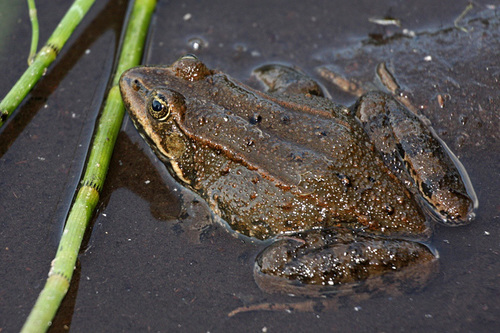
Columbia Spotted Frog
Rana luteiventris
A permanent resident of Western wetlands, the Columbia Spotted Frog is easily identified by its 'upturned' eyes and distinctive reddish-orange belly wash. Unlike more adventurous frogs, this species stays close to home, spending its days basking on the water's edge.
Quick Identification
Size
4.5 to 10 cm (1.8 to 4 inches) in length; females are typically larger than males.
Colors
Olive-green, tan, or dark brown dorsal surface with irregular black spots; creamy white upper lip and belly, often featuring a vibrant salmon or reddish-orange wash on the underside of the hind legs.
Key Features
- Relatively short back legs compared to other Rana species
- Upturned eyes positioned near the top of the head
- Narrow snout and extensive webbing on the hind feet
- Salmon-colored belly wash in adults
When You’ll See Them
Geographic range
Where Does the Columbia Spotted Frog Live?
The Columbia Spotted Frog is a native treasure of Western North America, primarily occupying the rugged landscapes of the Pacific Northwest and the Rocky Mountain corridor. Its core range extends from Southeast Alaska and British Columbia southward through Washington, Oregon, Idaho, Montana, and Wyoming. While broadly distributed in the north, isolated and sensitive populations can also be found in the Great Basin regions of Nevada and Utah, often clinging to rare permanent spring habitats in an otherwise arid landscape.
Basemap © OpenStreetMap contributors
Behavior
The Columbia Spotted Frog is one of the most aquatic-oriented frogs in North America, rarely venturing far from the safety of a permanent water source. Unlike many other ranid frogs that may forage in damp meadows, this species prefers to spend its day basking on floating vegetation or muddy banks where it can leap into the water at the first sign of a predator. They are primarily diurnal, meaning they are most active during daylight hours when they soak up the sun to regulate their body temperature.
Socially, these frogs are relatively quiet compared to their more boisterous cousins. Their call is a low-pitched, rapid series of 'clucks' that sounds somewhat like a distant woodpecker or a finger clicking against a hollow log. During the winter, they enter a state of dormancy, hibernating at the bottom of deep ponds or in spring-fed areas that do not freeze solid, often congregating in groups to share these thermal refuges.
EverydayEarth exclusive
Camera Tips
Capturing the Columbia Spotted Frog on a backyard or trail camera requires a specialized approach because they are cold-blooded and small. Traditional Passive Infrared (PIR) sensors often fail to trigger for frogs because they don't give off enough body heat. To succeed, set your camera to 'Time Lapse' mode, taking a photo every 1 to 2 minutes during peak daylight hours. This 'blind' shooting method is the most reliable way to catch them basking without relying on a motion trigger.
Placement is everything. Look for 'basking platforms'—flat rocks, partially submerged logs, or matted lily pads near the water’s edge. Position your camera just a few inches above the ground or water level, angled slightly upward. This low-profile perspective captures the distinct upturned eyes and the characteristic spotting on their backs. If your camera allows for it, use a macro lens or a focal distance of 3-5 feet to ensure the small subject remains sharp in the frame.
Environmental factors play a huge role in their visibility. The best time to capture activity is on sunny days following a spring rain. In backyard pond settings, place the camera near the shallow 'shelf' area where emergent plants like cattails grow. These frogs love cover, so aim the camera at a small clearing within the vegetation. Avoid using bright white flashes at night; while they are mostly diurnal, a low-glow infrared flash is better if you hope to catch them during their occasional evening movements without startling them.
Similar Species
Species that look similar or are commonly confused with Columbia Spotted Frog.
Oregon Spotted Frog
Nearly identical but has even more webbing on the hind feet and is much rarer, found only in specific Pacific Northwest lowlands.
Northern Red-legged Frog
Has longer legs, eyes that face more to the side, and lacks the extensive toe webbing of the Columbia Spotted Frog.
American Bullfrog
Much larger with a very prominent circular eardrum (tympanum) and lacks the dark spots with light centers found on spotted frogs.
Frequently Asked Questions
Record Columbia Spotted Frog at your habitat
Connect a camera to start building your own species record — AI identifies every visitor automatically.