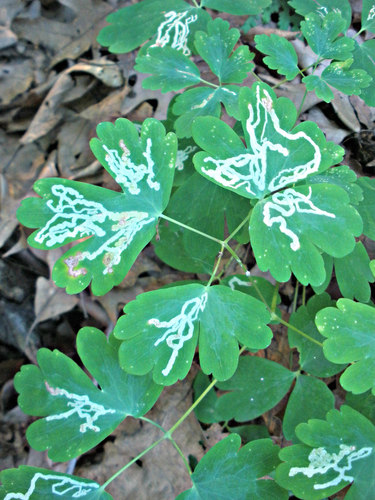
columbine leafminer
Phytomyza aquilegivora
The columbine leafminer is a tiny garden architect that turns leaves into living canvases. While the adult fly is nearly invisible, its winding white trails tell a fascinating story of survival hidden in plain sight.
Quick Identification
Size
Adult flies are 1.5–2.5 mm (1/16 to 1/10 inch) long; larval mines can reach 5–10 cm (2–4 inches) in length.
Colors
Adults are matte dark grey to black with subtle yellow markings on the head and leg joints; larvae are translucent pale yellow or green.
Key Features
- Distinctive winding, serpentine white or tan trails on columbine leaves
- Tiny, dark-bodied flies with yellowish heads
- Dark specks of frass (waste) visible within the leaf mines
- Highly host-specific, found almost exclusively on Aquilegia species
When You’ll See Them
Geographic range
Where Does the columbine leafminer Live?
Native to North America, the columbine leafminer is a widespread resident throughout the Eastern and Central United States and Southern Canada. It is most commonly found in regions where its primary host plant, the Eastern Red Columbine, thrives naturally, but it has expanded its reach into suburban landscapes wherever ornamental columbines are planted. While its core range is concentrated in the temperate deciduous zones of the Northeast and Midwest, it can be spotted as far south as the Carolinas and as far west as the Great Plains.
Basemap © OpenStreetMap contributors
Behavior
The columbine leafminer is best known for the artistic, winding patterns its larvae leave within the foliage of columbine plants. The life cycle begins when the female adult fly uses her ovipositor to puncture the leaf surface and deposit eggs. While the adults are rarely noticed by casual observers, their presence is betrayed by these small 'stipple' marks where they feed on plant sap or lay their eggs.
Once the eggs hatch, the tiny larvae spend their entire developmental stage living between the upper and lower layers of the leaf. They munch through the mesophyll tissue, creating the characteristic 'mines' that widen as the larvae grow. This behavior protects them from many external predators and environmental stressors, though specialized parasitic wasps often find them. When the larvae are ready to pupate, they typically emerge from the leaf and drop to the soil, where they transform into adults to begin the cycle anew.
EverydayEarth exclusive
Camera Tips
Capturing the columbine leafminer requires a shift in perspective, focusing on macro photography and time-lapse rather than traditional wildlife triggers. Because the adults are so small, you should set your camera on a tripod and focus specifically on a cluster of fresh columbine leaves in late spring. Use a macro lens or a camera with a high-quality 'close-up' mode. Position the lens 3-6 inches from the leaf surface, ensuring the area is well-lit by natural dappled sunlight.
The most rewarding way to document this species is through time-lapse photography. Set your camera to take a photo every hour over the course of several days once you notice a small, fresh mine starting to form. When played back, you will see the 'tunnel' grow and wind across the leaf in real-time as the larva feeds. This provides a fascinating look at insect development that is usually invisible to the naked eye.
To capture the adult flies, aim your camera at the flowers or the upper surface of the leaves during the warmest part of the day. They are attracted to the host plant for mating and egg-laying. Since they are too small to trigger most motion sensors, use a 'burst' mode or video setting if your AI camera allows for continuous recording based on pixel-change detection. Look for tiny dark specks that land briefly and move with a jerky, erratic flight pattern.
Similar Species
Species that look similar or are commonly confused with columbine leafminer.
Frequently Asked Questions
Record columbine leafminer at your habitat
Connect a camera to start building your own species record — AI identifies every visitor automatically.