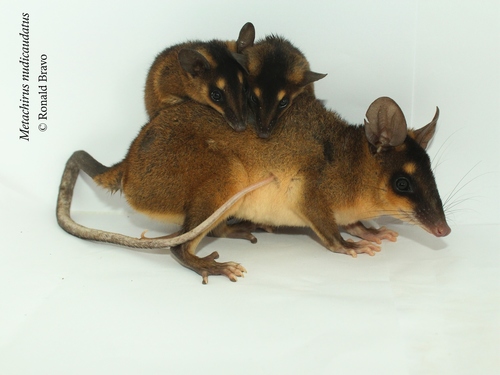
Common Brown Four-eyed Opossum
Metachirus myosuros
The Common Brown Four-eyed Opossum is a master of the midnight forest floor, recognizable by the twin white spots that sit like a second pair of eyes above its brow. This pouchless wanderer is an essential part of the Neotropical ecosystem, darting through the undergrowth with surprising speed.
Quick Identification
Size
Head and body length of 25–31 cm (10–12 in), with a long tail of 33–39 cm (13–15 in); weight ranges from 500 to 1,500 g (1.1–3.3 lbs).
Colors
Rich cinnamon-brown or reddish-brown upperparts with creamy-white or pale yellow underparts; distinctive white spots located above each eye.
Key Features
- Two prominent white spots above the eyes giving a 'four-eyed' appearance
- Long, slender, and entirely hairless tail
- Lacks a permanent pouch for offspring
- Longer hind legs adapted for running on the forest floor
When You’ll See Them
Geographic range
Where Does the Common Brown Four-eyed Opossum Live?
This species is a quintessential Neotropical resident, native to the vast forested landscapes of Central and South America. Its range begins in the north in Nicaragua and extends south through Panama into the Amazon Basin, covering significant portions of Colombia, Peru, and Bolivia. It reaches its southern limits in the Atlantic forests of Brazil, Paraguay, and northern Argentina.
Basemap © OpenStreetMap contributors
Behavior
The Common Brown Four-eyed Opossum is a strictly nocturnal and solitary marsupial. Unlike many of its cousins in the Didelphidae family, this species is primarily terrestrial, spending the vast majority of its time patrolling the forest floor rather than climbing in the canopy. It is a fast and agile mover, using its elongated hind limbs to navigate through leaf litter in search of food. During the day, it retreats to well-hidden nests made of dried leaves, often tucked into hollow logs, under tree roots, or in burrows.
While generally shy and elusive, these opossums are known for their defensive displays if cornered, which include hissing and baring their teeth. Interestingly, females lack the typical marsupial pouch; instead, the young cling to the mother's teats and fur as she moves through the undergrowth. They are not known to be territorial in the traditional sense, but individuals generally avoid one another except during the breeding season.
EverydayEarth exclusive
Camera Tips
To capture the Common Brown Four-eyed Opossum on camera, you must focus on the forest floor. Because they are terrestrial runners, place your camera very low—about 20 to 30 centimeters (8-12 inches) off the ground. Angle the camera slightly upward or keep it parallel to the ground to ensure you catch the distinctive white eye-spots and the long tail. Standard trail camera heights intended for deer or larger mammals will likely overshoot this species or only capture the tips of its ears.
Since they are strictly nocturnal, ensure your camera has a high-quality infrared flash that won't overexpose subjects at close range. These opossums move relatively quickly when foraging, so a fast trigger speed (0.3 seconds or less) and a wide-angle lens are beneficial. If your camera supports it, high-speed video mode is excellent for observing their unique 'running' gait, which is quite different from the slow climbing of other opossums.
Baiting can be very effective for bringing them into the center of the frame. Use aromatic fruits like overripe bananas, mangoes, or even a small amount of canned sardines to mimic the scent of the protein they hunt. Place the bait in a clear patch of leaf litter to avoid grass or twigs triggering the PIR sensor. In backyard settings bordering tropical forests, placing the camera near a permanent water source or a compost pile often yields the best results.
Similar Species
Species that look similar or are commonly confused with Common Brown Four-eyed Opossum.
Gray Four-eyed Opossum
Grayer fur, females have a well-developed pouch, and it is much more likely to be seen climbing in trees.
Virginia Opossum
Much larger, with a white face and shaggy gray-white fur, and lacks the distinct 'four-eyed' spots.
Water Opossum
Has a distinctive black and gray banded pattern and webbed hind feet for swimming.
Frequently Asked Questions
Record Common Brown Four-eyed Opossum at your habitat
Connect a camera to start building your own species record — AI identifies every visitor automatically.