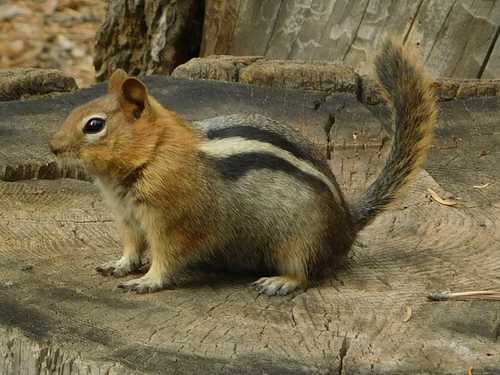
Common Golden-mantled Ground Squirrel
Callospermophilus lateralis
Often mistaken for a giant chipmunk, this colorful mountain-dweller is famous for its golden shoulders and bold personality. A frequent visitor to western campsites and rocky backyards, it’s a favorite subject for trail camera enthusiasts.
Quick Identification
Size
23–30 cm (9–12 in) in length; 120–390 g (4.2–13.8 oz) in weight
Colors
Coppery-red or golden-brown head and shoulders; grayish-brown rump; white lateral stripe bordered by two black stripes on each side; white eye ring; no facial stripes.
Key Features
- Golden-red head and shoulders
- Bold white stripe with black borders on sides
- No stripes on the face or through eyes
- Thick, bushy tail that is relatively short
When You’ll See Them
Geographic range
Where Does the Common Golden-mantled Ground Squirrel Live?
Native to the rugged mountain ranges of western North America, the Common Golden-mantled Ground Squirrel has a vast distribution. Its territory spans the Canadian Rockies in British Columbia and Alberta, extending southward through the western United States into the Sierra Nevada, the Cascades, and the Great Basin. This species is a staple of the high-country landscape in states such as Washington, Oregon, California, Idaho, Montana, and Colorado, where it thrives in sun-drenched, rocky environments.
Basemap © OpenStreetMap contributors
Behavior
These squirrels are true hibernators, spending up to seven months of the year in deep underground burrows. To survive the winter, they spend the summer and autumn months in a state of hyperphagia, consuming large quantities of food and storing fat. They also have expansive cheek pouches, which they use to transport seeds and nuts to underground caches. They are remarkably bold around humans, often becoming habituated to presence in campsites and backyards, where they may even 'beg' for food.
EverydayEarth exclusive
Camera Tips
Since they are highly motivated by scent and food, a small handful of unsalted sunflower seeds, chopped walnuts, or even a smear of almond butter on a rock can be an effective lure. Place the bait 5 to 10 feet in front of the lens to ensure they stay in the frame long enough for a clear shot or a high-quality video clip. Always check local wildlife regulations before using bait, and avoid feeding them by hand to prevent habituation.
Timing is critical for this species; they are strictly diurnal and will not be seen after dusk. The best lighting conditions for photography are mid-morning or late afternoon when the sun isn't directly overhead, highlighting the golden fur on their shoulders. Because they hibernate for a significant portion of the year, your window for capturing them is limited to the warmer months. In high-altitude areas, they may not emerge until June and could return to their burrows as early as late September, so plan your deployments for mid-summer for the highest chance of success.
Similar Species
Species that look similar or are commonly confused with Common Golden-mantled Ground Squirrel.
Yellow-pine Chipmunk
Smaller with distinct stripes across the face and eyes, which ground squirrels lack.
Cascade Golden-mantled Ground Squirrel
Very similar but typically found only in the Cascade Range; often has a duller mantle and slightly different tail coloration.
Least Chipmunk
Much smaller and thinner, with stripes that extend all the way to the base of the tail and across the face.
Frequently Asked Questions
Record Common Golden-mantled Ground Squirrel at your habitat
Connect a camera to start building your own species record — AI identifies every visitor automatically.