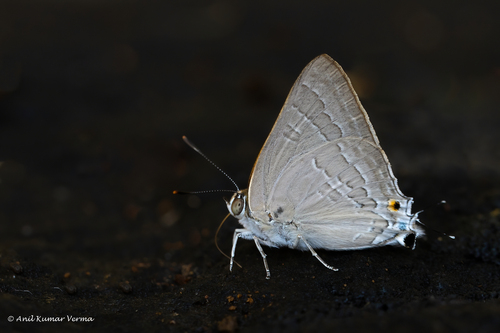
Common Guava Blue
Virachola isocrates
A striking violet butterfly often found dancing around backyard fruit trees, the Common Guava Blue is a master of the orchard.
Quick Identification
Size
Wingspan of 34–50 mm (1.3–2.0 inches)
Colors
Males are a brilliant glossy violet-blue on the upper side; females are brownish with a distinct orange patch on the forewing. Both sexes feature grey-brown undersides with white-edged bands and prominent orange-ringed black eye-spots on the hindwings.
Key Features
- Slender tails on the hindwings
- Orange-crowned black eye-spots on the underside near the tail
- Glossy violet-blue upper wings in males
- White wavy lines across the underside of both wings
When You’ll See Them
Geographic range
Where Does the Common Guava Blue Live?
The Common Guava Blue is a staple of the Indomalayan realm, stretching its wings across a vast territory in South and Southeast Asia. It is natively found throughout the Indian subcontinent, from the base of the Himalayas to the tropical tip of Sri Lanka. Its range extends eastward into Indochina, covering countries like Myanmar, Thailand, and Vietnam, where it thrives in both rural landscapes and densely populated urban centers with backyard fruit trees.
Basemap © OpenStreetMap contributors
Behavior
The Common Guava Blue is a swift and erratic flyer, often seen darting between fruit trees in suburban gardens and orchards. Unlike many butterflies that spend their time exclusively on flowers, this species is closely tied to its host plants—specifically fruit-bearing trees like pomegranate and guava. They are highly territorial, and males can often be seen perching on high leaves, darting out to chase away rivals before returning to the same spot.
Females are particularly interesting to observe as they exhibit a methodical searching behavior. They fly slowly around fruit clusters, drumming their legs on the fruit surface to 'taste' it before depositing a single white egg near the stalk. While they are considered a pest in commercial agriculture due to their larvae boring into fruit, in a backyard setting, they are fascinating examples of specialized evolutionary niches.
EverydayEarth exclusive
Camera Tips
To capture the Common Guava Blue on your backyard camera, focus your efforts on fruit-bearing trees rather than just flowers. If you have a pomegranate or guava tree, position your camera about 2 to 3 feet away from a cluster of young fruit. Because these butterflies are small, a camera with a macro lens or a close-focusing capability is essential. Angle the camera slightly upward to catch the flash of violet on the male's upper wings when they land.
Lighting is your best friend with this species. They are most active in full sun, which helps highlight the iridescent blue of the males. If your camera allows for manual shutter speed settings, aim for 1/1000s or faster to freeze their rapid wing beats. Using a tripod is highly recommended, as the small size of the butterfly makes even slight camera movements very distracting in the final shot.
Timing is critical; monitor your fruit trees during the morning hours when the sun first hits the leaves. This is when the butterflies typically emerge to bask and warm their flight muscles. If you don't have fruit trees, try planting nectar-rich 'butterfly magnets' like Buddleja or Lantana nearby to lure them into the camera's field of view while they refuel.
Similar Species
Species that look similar or are commonly confused with Common Guava Blue.
Frequently Asked Questions
Record Common Guava Blue at your habitat
Connect a camera to start building your own species record — AI identifies every visitor automatically.