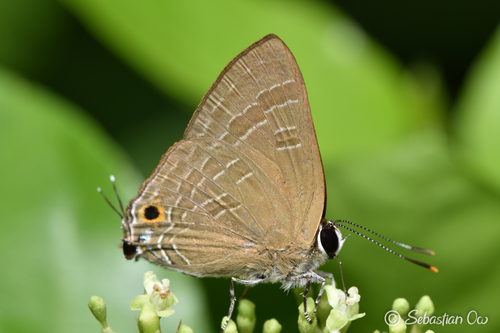
Cornelian
Deudorix epijarbas
A jewel of the canopy, the Cornelian butterfly dazzles with its fiery orange-red wings and delicate, hair-like tails. Often found darting through orchards and tropical gardens, this vibrant lycaenid is a favorite for backyard naturalists across the Indo-Pacific.
Quick Identification
Size
Wingspan of 34-44 mm (1.3-1.7 inches)
Colors
Males are brilliant orange-red (cinnabar) with black borders; females are duller brown or ochre. Both have grey-brown undersides with white wavy lines.
Key Features
- Brilliant cinnabar-red upperside in males
- Delicate filamentous tails on the hindwings
- Prominent black 'eye' spot on the underside hindwing
- Intricate white wavy lines on a brown underside
- Swift, jerky flight pattern
When You’ll See Them
Geographic range
Where Does the Cornelian Live?
The Cornelian is a wide-ranging resident of the Indo-Pacific, spanning from the Indian subcontinent across Southeast Asia to the tropical fringes of Australia and the remote islands of Fiji. It thrives in various landscapes, from the foothills of the Himalayas in India and Nepal to the lush coastal rainforests of Queensland, and is commonly spotted in urban gardens and fruit orchards throughout the Philippines and Indonesia.
Basemap © OpenStreetMap contributors
Behavior
The Cornelian is a high-energy butterfly known for its rapid and erratic flight style. Males are particularly territorial, often choosing a prominent leaf or twig as a 'lookout' perch where they bask in the sun and chase off any intruding insects. They are most active during the warmest hours of the day, frequently visiting flowers for nectar or congregating at damp patches on the ground for 'puddling' to extract essential minerals.
Unlike many other butterflies, the Cornelian's life cycle is closely tied to the fruit of its host plants. Females lay their eggs on the surface of developing fruits, and the emerging larvae bore inside to feed on the seeds. This makes them a frequent visitor to backyard orchards and gardens, though they often remain high in the canopy or hidden within foliage, making them a rewarding challenge for wildlife observers to spot.
EverydayEarth exclusive
Camera Tips
To capture the Cornelian on camera, focus your efforts on fruit-bearing trees like Pomegranate (Punica granatum) or Rambutan, which serve as primary host plants. Positioning your camera near the mid-canopy level or focusing on developing fruit clusters is key, as females will frequent these areas to deposit eggs. Use a macro lens or a camera with a high-resolution sensor, as these butterflies are small and move quickly. Setting your AI trigger to a high sensitivity will help capture their rapid arrivals and departures.
Sunlight is your best friend when filming this species. Place your camera in a spot that receives direct morning or midday sun, particularly on flat, broad leaves where males like to bask. The iridescent red of the male’s wings is most spectacular when caught in full light. If you are using a trail camera, ensure the focal distance is locked to a specific branch or flower cluster to avoid the 'searching' blur that occurs with fast-moving insects.
For the best results, look for 'puddling' sites if you have a damp area in your yard or a birdbath with shallow edges. Cornelians often descend to the ground to drink mineral-rich water. Setting a camera at ground level near a small muddy patch can provide unique angles of their intricate underside markings and 'hairy' tails. In gardens, flowering shrubs like Lantana or Ixora are excellent magnets; aim the camera at the most sun-drenched blooms for the highest chance of a clear shot.
Similar Species
Species that look similar or are commonly confused with Cornelian.
Frequently Asked Questions
Record Cornelian at your habitat
Connect a camera to start building your own species record — AI identifies every visitor automatically.