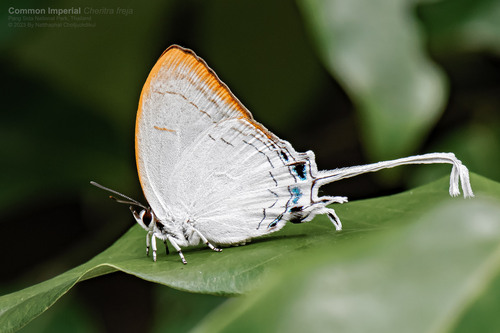
Common Imperial
Cheritra freja
Adorned with cascading white streamers, the Common Imperial is one of the most regal sights in the Asian tropics. This elusive forest butterfly uses its stunning tails and 'false eyes' to perform a clever dance of survival in the dappled shade.
Quick Identification
Size
38-48 mm (1.5-1.9 inches) wingspan
Colors
Rich chocolate brown on upper wings (males have a purple-blue sheen); creamy-white underside with orange and black spots at the tail base
Key Features
- Two pairs of long, white, thread-like tails on the hindwings
- Creamy-white underside with thin, dark transverse lines
- Distinctive orange and black 'eye spots' near the tail base
- Hanging posture with wings closed when resting
When You’ll See Them
Geographic range
Where Does the Common Imperial Live?
The Common Imperial is native to the Indo-Malayan realm, thriving across a wide swathe of South and Southeast Asia. Its presence is most notable in India, Sri Lanka, and Thailand, extending through the Malay Peninsula into Singapore and the Indonesian islands. It is a quintessential species of the humid tropics, rarely found far from the dense, evergreen vegetation of its ancestral forest homes.
Basemap © OpenStreetMap contributors
Behavior
The Common Imperial is a master of deception and elegance within the forest undergrowth. Unlike many butterflies that spend their time basking in open sunlight, this species is typically found in the dappled shade of forest edges or lush gardens. It has a unique habit of resting on the undersides of leaves with its wings tightly closed, a behavior that protects it from rain and keeps it hidden from aerial predators.
Its most fascinating behavior involves the use of its long, white tails. When perched, the butterfly often moves its hindwings slightly, making the tails twitch. This movement, combined with the 'false eyes' at the base of the wings, mimics the appearance of a head with antennae. This 'deflection' strategy tricks birds into attacking the expendable tails rather than the butterfly's actual head, allowing it a chance to escape with only minor wing damage.
EverydayEarth exclusive
Camera Tips
Capturing the Common Imperial on a backyard or trail camera requires a specialized approach because of their small size and specific resting habits. To increase your chances, mount your camera near known larval host plants or nectar-rich flowers like Ixora. Position the camera at a height of about 3 to 4 feet (1-1.2 meters) from the ground, angled slightly upward toward the undersides of large leaves where they often roost. Using a camera with a macro mode or a high-resolution sensor is vital for capturing the delicate, thread-like tails.
Because these butterflies are most active during the warmest hours of the day, ensure your camera is positioned in a spot that receives bright, filtered sunlight between 10 AM and 2 PM. Standard trail cameras might struggle with the small motion of a butterfly; if possible, use a camera with a 'high sensitivity' PIR sensor or one that allows for time-lapse recording at 5-10 second intervals. This ensures you catch the butterfly even if its quick movements don't trigger a traditional motion sensor.
A unique trick for attracting the Common Imperial to your camera's field of view is to create a 'puddling' station. Place a shallow tray of damp, salted sand or a piece of overripe fruit (like fermented banana) in a sun-dappled spot. This will lure males looking for minerals. For the best results, use a fast shutter speed (1/500s or higher) to freeze the motion of their erratic flight and ensure the white tails don't become a blur in the humid forest light.
Similar Species
Species that look similar or are commonly confused with Common Imperial.
Frequently Asked Questions
Record Common Imperial at your habitat
Connect a camera to start building your own species record — AI identifies every visitor automatically.