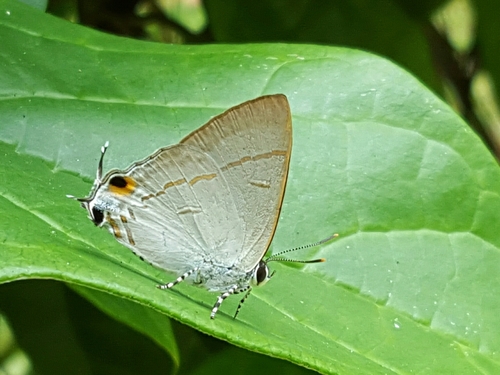
Common Tit
Hypolycaena erylus
A master of disguise with 'false' antennae and shimmering wings, the Common Tit is one of the most charismatic small butterflies found in Asian gardens.
Quick Identification
Size
Wingspan of 32–38 mm (1.2–1.5 inches); total body length approx 25 mm.
Colors
Males have dark brownish-black uppersides with a subtle purple-blue sheen; females are matte brown. Both sexes feature silvery-grey undersides with orange-bordered black bands and white-tipped tails.
Key Features
- Two unequal, hair-like tails on each hindwing
- Silvery-grey underside with distinct orange and black transverse lines
- Prominent orange 'eye-spots' at the base of the tails
- Fast, erratic flight low to the ground
When You’ll See Them
Geographic range
Where Does the Common Tit Live?
The Common Tit is a widespread resident of the Asian tropics and subtropics. Its native range begins in the Indian subcontinent, covering the Himalayan foothills, the Western Ghats, and Northeast India, and extends eastward through Myanmar, Thailand, and the Malay Peninsula. It is also commonly found across the Indonesian archipelago and the Philippines, thriving in both wild jungles and human-altered landscapes.
Basemap © OpenStreetMap contributors
Behavior
The Common Tit is an active and energetic butterfly, often seen darting between sunlit patches in forested areas or suburban gardens. It is particularly known for its 'false head' defense strategy. When perched, it frequently twitches its hindwings, causing the long, delicate tails to move like antennae. This trickery misleads predators, such as birds or spiders, into attacking the less-vulnerable wing edges rather than the butterfly's actual head.
While they are relatively solitary, males can be found in small groups participating in 'mud-puddling.' This involves congregating on damp soil or riverbanks to suck up essential minerals and salts. They are territorial and will often return to the same favorite perch after a short flight. Unlike some more reclusive species, the Common Tit is quite bold and can be observed at close range once it has settled to feed on nectar or moisture.
EverydayEarth exclusive
Camera Tips
To capture the Common Tit on a backyard camera, focus your efforts on 'puddling' stations or nectar-rich flowering plants. If you are using an AI-powered camera, place it approximately 1 to 2 feet away from low-growing flowers like Lantana or Ixora. Because these butterflies are small, a macro lens attachment or a camera with a high-resolution sensor is essential to capture the intricate details of their tails and wing markings.
Try creating a damp patch of soil in a sunny spot of your yard, perhaps mixed with a tiny pinch of sea salt or organic compost, to attract males for mud-puddling. Set your camera to a high shutter speed or a high-frame-rate video mode; the Common Tit's wing-twitching behavior is rapid, and slower settings will result in motion blur. For the best color, ensure the camera is positioned to catch the morning sun, which highlights the subtle purple sheen on the male's wings.
Since these butterflies are most active during the warmest parts of the day, configure your camera's PIR sensor for maximum sensitivity during late morning and early afternoon. If you are using a trail camera, look for 'flight paths'—they often fly along the same garden edges or hedges repeatedly. Position your camera at knee-height to match their typical flight level near the ground.
Similar Species
Species that look similar or are commonly confused with Common Tit.
Orchid Tit
The Orchid Tit has more irregular, broken bands on the underside and typically prefers higher humidity environments.
Fluffy Tit
Identified by much larger, broader white tails and a more 'fluffy' appearance on the hindwing margins.
Common Imperial
Larger in size with much longer, more prominent white tails and a bright orange underside.
Frequently Asked Questions
Record Common Tit at your habitat
Connect a camera to start building your own species record — AI identifies every visitor automatically.