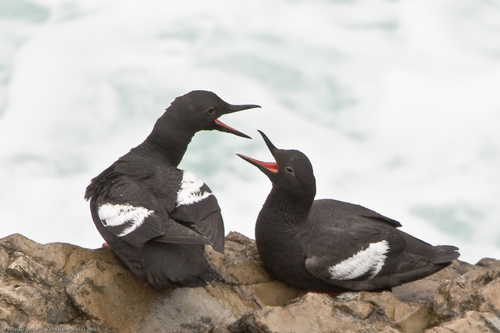
Pigeon Guillemot
Cepphus columba
With their striking red feet and tuxedo-like plumage, Pigeon Guillemots are the most approachable acrobats of the Pacific coastline. These resilient divers bring a touch of wild ocean life right to the docks and rocky shores of coastal backyards.
Quick Identification
Size
Length: 30–37 cm (12–14.5 in); Wingspan: 58–70 cm (23–27.5 in); Weight: 450–550 g (1–1.2 lbs)
Colors
Breeding adults are charcoal-black with a white wing patch containing a dark wedge; non-breeding adults are mottled grey and white. Both have distinctive bright red feet and a red gape (mouth interior).
Key Features
- Bright coral-red legs and feet
- Large white wing patch broken by a black triangle
- Thin, pointed black bill
- Vibrant red interior of the mouth visible during calls
When You’ll See Them
Behavior
Pigeon Guillemots are charismatic members of the auk family, often nicknamed "sea pigeons" due to their appearance and the whistling sounds they make. Unlike many of their deep-sea relatives, these birds prefer to stay close to the shore, making them much easier for coastal residents to spot. They are highly social during the breeding season, performing elaborate "water dances" where pairs and groups chase each other in circles on the surface, accompanied by high-pitched piping whistles.
When foraging, they are exceptional divers, using their wings to effectively "fly" underwater. They search the sea floor for bottom-dwelling prey, often staying submerged for 10 to 30 seconds at a time. While they can be wary of direct human approach, they are surprisingly tolerant of human infrastructure and are frequently seen nesting in the crevices of old piers, wharves, and even drainage pipes in busy harbors.
EverydayEarth exclusive
Camera Tips
To capture high-quality footage of Pigeon Guillemots, your camera placement should focus on "landings." If you have a coastal property with rocky bluffs or a dock, look for white streaks of guano which indicate frequent perching spots. Mount your camera 2–4 feet off the ground, angled slightly upward to catch them as they fly in from the water. Because they are charcoal-colored, use a camera with a high dynamic range to avoid losing detail in their dark feathers against a bright ocean background.
The most sought-after shot is the "delivery." During the summer months, parents carry whole fish in their bills back to their chicks. Set your camera’s trigger speed to its fastest setting and use a burst mode (Photo) or high-frame-rate video to capture the moment they land with a shimmering fish. Positioning a camera near a known nesting crevice—from a safe distance of at least 10 feet to avoid disturbing the nest—is the best way to document this behavior.
In terms of timing, these birds are most active around the shoreline during mid-to-high tides when their prey is more accessible in the shallows. While they don't respond to traditional birdseed, you can sometimes attract them closer to a dock-mounted camera by providing a stable, flat perching surface above the high-water mark. Early morning light is your best friend; the low sun angle will illuminate the brilliant red of their feet and the inside of their mouths when they vocalize, creating a stunning visual contrast with their dark plumage.
Similar Species
Species that look similar or are commonly confused with Pigeon Guillemot.
Black Guillemot
Found in the Atlantic; its white wing patch is solid and lacks the dark black wedge found on the Pigeon Guillemot.
Common Murre
Much larger and lacks the white wing patches; murres have a white 'tuxedo' belly even in breeding season.
Marbled Murrelet
Significantly smaller with a shorter bill; they lack the bright red feet and large white wing patches.
Frequently Asked Questions
Record Pigeon Guillemot at your habitat
Connect a camera to start building your own species record — AI identifies every visitor automatically.