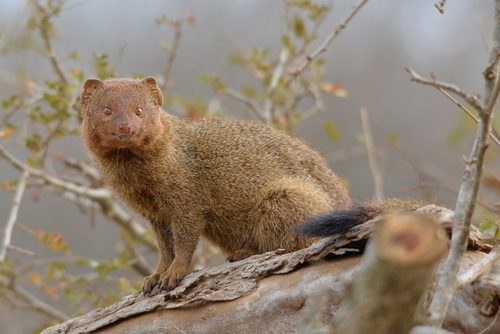
Common Slender Mongoose
Herpestes sanguineus
The Common Slender Mongoose is Africa's most iconic backyard predator, known for its sleek silhouette and its signature black-tipped tail. Active by day and incredibly agile, this clever hunter is a master of both the ground and the treetops.
Quick Identification
Size
Body length 27-34 cm (10-13 in) with a tail of 23-31 cm (9-12 in); weight ranges from 400-800g (0.9-1.8 lbs)
Colors
Variable coat ranging from reddish-brown to yellowish-grey; distinctive black tip on the tail is constant across all variations
Key Features
- Distinctive black tip on the end of the tail
- Long, slender body with a pointed snout
- Tail often held in an upward 'J' curve when running
- Diurnal activity pattern, primarily seen during daylight
- Small, rounded ears set low on the head
When You’ll See Them
Sightings on EverydayEarth
Jul 27, 2026
A Slender Mongoose and a Common Dwarf Mongoose are seen interacting on a large fallen log. The Slender Mongoose approaches the Dwarf Mongoose and stands briefly on its hind legs to investigate. They share a close moment on the log before both move toward the foreground and eventually out of the frame into the dry grass.
Jul 23, 2026
A Common Slender Mongoose is briefly visible on the left bank of the watering hole. It moves quickly along the edge of the water before darting back into the safety of the dry brush. The surrounding landscape remains quiet with the sounds of local birds in the background.
Jul 9, 2026
A Common Slender Mongoose is positioned on the left bank of the watering hole. It stays low to the ground, briefly drinking from the water's edge before suddenly darting away into the dry brush as a small bird flies quickly across the frame.
May 10, 2026
A slender mongoose is seen walking along the far bank of a waterhole. It moves steadily through the dry grass and dirt before disappearing into the brush.
Geographic range
Where Does the Common Slender Mongoose Live?
Native to the vast landscapes of sub-Saharan Africa, the Common Slender Mongoose is one of the most widely distributed small carnivores on the continent. Its expansive range stretches from the southern edges of the Sahara Desert down to South Africa, covering almost every nation in between, including Kenya, Tanzania, Namibia, and Botswana. While it successfully avoids the most extreme desert interiors and the densest tropical rainforests of the Congo Basin, it thrives in nearly every other African environment, particularly where there is a mix of open ground and protective cover.
Basemap © OpenStreetMap contributors
Behavior
The Common Slender Mongoose is a highly adaptable and largely solitary carnivore. Unlike many of its cousins that prefer the night, this species is strictly diurnal, making it one of the most frequently sighted mongooses in Africa. They are remarkably agile climbers, often ascending trees to hunt for birds, eggs, or to escape predators, a trait that sets them apart from more terrestrial mongoose species.
Socially, they are typically seen alone, though males may occasionally form small bachelor groups or share overlapping territories with several females. They are not particularly territorial toward the opposite sex but will defend their range against same-sex intruders. In suburban environments, they have become quite bold, often scouting through gardens and using man-made structures like drainpipes or woodpiles for cover.
EverydayEarth exclusive
Camera Tips
Since the Common Slender Mongoose is active during the day, you don't need to rely on infrared night vision to get great shots. Place your camera along 'edge' habitats, such as the boundary between a lawn and a brush pile, or near the base of large trees. They are creatures of habit and often use the same paths daily to patrol their territory, so look for small, flattened trails in the grass or low-lying vegetation.
Set your camera at a low height—about 20 to 30 centimeters (8-12 inches) off the ground—to capture their sleek profile at eye level. Because they move with a quick, nervous energy, a fast trigger speed is essential; otherwise, you might only capture a blurry black-tipped tail leaving the frame. If your camera allows for 'Burst Mode' or 'Photo+Video,' use it to capture their characteristic high-stepping trot.
To encourage a visit, you don't necessarily need bait, but providing a safe, 'complex' environment helps. A stack of old logs or a rockery serves as a natural magnet because it attracts the insects and lizards that the mongoose hunts. If you are using a lure, a small amount of wet cat food or a cracked egg placed near a fallen branch can stop them long enough for a clear photo, though they are naturally wary and may take several days to trust a new object in their environment.
Similar Species
Species that look similar or are commonly confused with Common Slender Mongoose.
Frequently Asked Questions
Record Common Slender Mongoose at your habitat
Connect a camera to start building your own species record — AI identifies every visitor automatically.