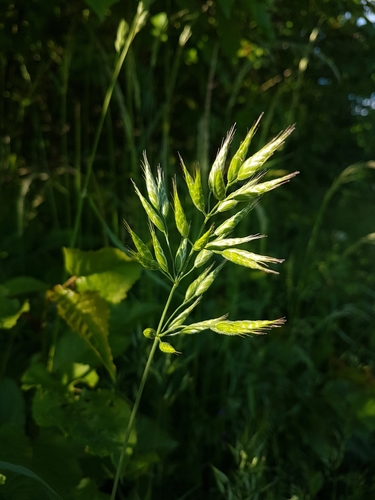
common soft brome
Bromus hordeaceus
A velvety-soft meadow grass that transforms backyard landscapes into shimmering waves of green and gold. Common soft brome is a master of adaptation, thriving in suburban lawns and wild pastures alike.
Quick Identification
Size
Stems typically reach 10–100 cm (4–40 inches) in height with leaf blades 2–7 mm wide.
Colors
Soft grayish-green foliage and seed heads, maturing to a pale tan or golden-straw color.
Key Features
- Densely covered in fine, soft white hairs (velvety texture)
- Compact, egg-shaped flower panicles 2–10 cm long
- Lemmas (seed husks) with short, straight bristles or awns
- Stems are erect or slightly spreading at the base
When You’ll See Them
Geographic range
Where Does the common soft brome Live?
Originally native to the temperate regions of Europe, North Africa, and Western Asia, common soft brome has successfully traveled across the globe alongside human migration and agriculture. It is now widely established throughout North America, particularly in the United States and Southern Canada, where it often dominates Mediterranean-style grasslands and open meadows. This hardy grass has also found a second home in the temperate zones of Australia, New Zealand, and parts of South America, making it one of the most widely distributed brome species in the world.
Basemap © OpenStreetMap contributors
Behavior
During the transition from late spring to summer, the plant undergoes a dramatic physiological change. It stops producing green leaves and funnels all its energy into the development of its seeds. The 'soft' nature of its seed heads is a defining characteristic, lacking the sharp, injurious spikes found in related grasses like ripgut brome. Once the seeds are fully mature and the plant has turned a parchment-like gold, it dies back, leaving its seeds to be dispersed by wind, water, or passing animals.
EverydayEarth exclusive
Camera Tips
Because this species is wind-pollinated, movement is its most dynamic feature. Use a camera with a high frame rate capability (60fps or 120fps) to capture slow-motion footage of the panicles swaying in the breeze. This emphasizes the grace of the plant and helps differentiate it from more rigid, upright grass species. If your camera has a macro lens or setting, focus specifically on the seed heads (panicles) to document the intricate overlapping pattern of the lemmas and their short, delicate awns.
For a long-term project, set up a time-lapse interval of one photo every 6 to 12 hours. Start this in early spring and continue through mid-summer. You will be rewarded with a fascinating sequence showing the grass emerging from a low rosette into tall, swaying stalks, followed by the rapid expansion of the flower heads and the eventual transition from vibrant green to a golden-tan as the seeds ripen. Ensure your camera is securely staked to the ground to prevent 'frame drift' caused by wind or soil shifting over the months.
Similar Species
Species that look similar or are commonly confused with common soft brome.
Frequently Asked Questions
Record common soft brome at your habitat
Connect a camera to start building your own species record — AI identifies every visitor automatically.