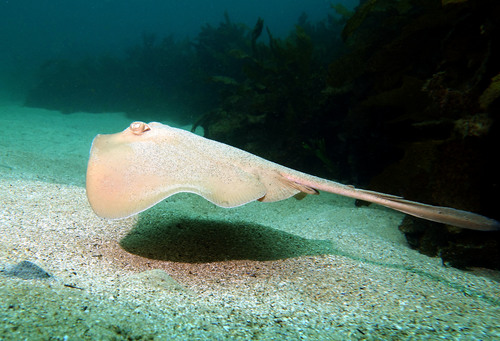
Common Stingaree
Trygonoptera testacea
Australia's most abundant inshore ray, the Common Stingaree is a master of the 'sand-dance,' blending perfectly into the estuaries and reefs of the eastern coast.
Quick Identification
Size
Total length up to 52 cm (20 in); disc width typically 20-30 cm (8-12 in)
Colors
Uniformly sandy brown to brownish-gray on the dorsal side; off-white or cream underside with darker outer edges
Key Features
- Rounded pectoral fin disc with a triangular snout
- Small dorsal fin located immediately in front of the stinging spine
- Leaf-shaped caudal fin at the tip of the tail
- Skirt-shaped skin curtain between nostrils with a fringed rear margin
When You’ll See Them
Geographic range
Where Does the Common Stingaree Live?
Native to the temperate and subtropical waters of the South Pacific, the Common Stingaree is found exclusively along the eastern coast of Australia. Its primary range spans from the warm waters of southern Queensland, through the entire coastline of New South Wales, and down into eastern Victoria. As a common inhabitant of the inner continental shelf, it is one of the most frequently encountered rays in Australia’s most populated coastal regions.
Basemap © OpenStreetMap contributors
Behavior
The Common Stingaree is a master of seafloor camouflage, spending much of its time partially buried in sand or mud. By using its pectoral fins to scoop sediment over its back, it becomes nearly invisible to predators, with only its eyes and spiracles—specialized openings used for breathing—poking through the surface. It is a generally docile species that relies on its cryptic coloration to avoid detection rather than aggression.
When foraging, these rays move with a graceful, undulating motion, gliding just centimeters above the bottom. They are often found in loose aggregations, particularly in nutrient-rich estuaries during high tide. While they possess a venomous spine for defense, they are not aggressive toward humans; however, their tendency to bury themselves in shallow water makes them a common cause of accidental 'stings' for unwary bathers stepping on them.
EverydayEarth exclusive
Camera Tips
Capturing the Common Stingaree on an AI-powered camera requires a waterproof setup, such as an underwater housing or a dedicated submersible trail camera. For the most engaging 'backyard' marine footage, mount your camera to a weighted base or a jetty pylon in an estuary. Position the lens 30 to 50 centimeters above the seafloor, angled slightly downward to capture the ray's intricate dorsal patterns and the way it disturbs the sand while feeding.
To guarantee a sighting, utilize a scent-based lure. A mesh bait bag filled with crushed prawns, squid, or oily fish scraps like pilchards works wonders. Secure the bait bag roughly one meter in front of the camera; the Stingaree's highly developed electro-receptors and sense of smell will lead it directly to the source, often resulting in close-up footage of its unique 'skirt-shaped' nasal curtain as it investigates the bag.
Pay close attention to the tides and water clarity. The best footage is usually captured during the 'slack' period of a high tide when water movement is minimal and visibility is at its peak. If your camera has infrared or white LED capabilities, use them for night shots, as these rays are highly active after dark. However, ensure the lights are diffused to prevent 'hot spots' on the sandy bottom which can wash out the image. In summer months, look for shallower water placement, as rays often move into warmer flats to pup.
Similar Species
Species that look similar or are commonly confused with Common Stingaree.
Frequently Asked Questions
Record Common Stingaree at your habitat
Connect a camera to start building your own species record — AI identifies every visitor automatically.