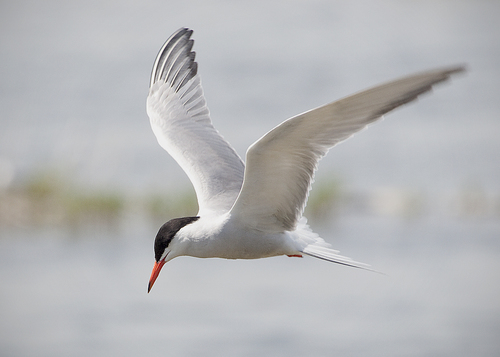
Common Tern
Sterna hirundo
A master of the air and sea, the Common Tern is a graceful visitor to shorelines across the globe. Known for its striking black cap and acrobatic diving, this elegant seabird is a symbol of summer for coastal and lakeside residents alike.
Quick Identification
Size
Length 31–35 cm (12–14 in), wingspan 77–98 cm (30–39 in), weight 110–145 g (3.9–5.1 oz)
Colors
Light grey upper wings and back, white underparts, distinctive jet-black cap, orange-red legs, and a red bill usually tipped with black.
Key Features
- Distinctive black cap extending to the eyes
- Slender, pointed orange-red bill with a black tip
- Deeply forked swallow-like tail
- Pale grey wings with dark primary feathers at the tips
When You’ll See Them
Geographic range
Where Does the Common Tern Live?
The Common Tern is a true global traveler, native to the temperate and subarctic regions of the Northern Hemisphere, spanning North America, Europe, and Asia. These birds are highly migratory, spending their summers breeding across the northern United States, Canada, and Eurasia before traveling south to winter along the tropical and subtropical coasts of South America, Africa, and Southern Asia. Because they rely on both coastal and inland water bodies, their range is expansive, covering nearly every continent during their annual cycle.
Basemap © OpenStreetMap contributors
Behavior
Common Terns are agile, social flyers known for their spectacular "plunge-diving" fishing technique. They are often seen hovering momentarily over water before diving headfirst to catch small fish. They are highly vocal birds, especially near nesting colonies, where they aggressively defend their territory against intruders, including humans and potential predators, often by dive-bombing and screeching.
During the breeding season, they engage in elaborate courtship displays involving "fish-flights," where a male carries a fish to attract and impress a mate. While they are colonial nesters, preferring to stay in large groups for safety, they are frequently seen hunting solo or in small pairs along coastlines and large inland lakes. Their interactions with humans are mostly limited to coastal sightings, though they are sensitive to disturbance at nesting sites.
EverydayEarth exclusive
Camera Tips
To capture the Common Tern on camera, focus on water-adjacent locations such as private docks, pier railings, or sandy shorelines where they frequently perch to rest or preen. Because they are highly mobile, setting up your camera on a tripod at a low angle near the water's edge provides the best perspective for their sleek profiles. Aim for a height of about 1 to 2 feet off the ground if targeting beach-resting birds, or mount it at eye level on a post if they are using a specific lookout point.
Since these birds are attracted to active fishing spots, placing your camera near shallow pools or "shallows" where minnows congregate can yield spectacular action shots of plunge-diving. While they aren't attracted to traditional bird feeders, you can encourage visits by providing a flat, elevated platform or a "loafing" log in a quiet area of a lakefront property. Ensure the camera is positioned to catch the morning or late afternoon light, which highlights the subtle grey and white tones of their plumage without blowing out the highlights.
Fast shutter speeds are essential for Common Terns. If your AI camera allows for manual adjustments, use a high "motion sensitivity" setting or a burst mode to capture their rapid movements. During the breeding season (May to July), keep a respectful distance from any suspected nesting sites to avoid disturbing the birds, as they can become aggressive and may dive-bomb the equipment. Instead, use a telephoto lens or a high-resolution sensor that allows for cropping in on the action.
Similar Species
Species that look similar or are commonly confused with Common Tern.
Arctic Tern
Has an all-red bill, shorter legs, and translucent primary feathers when seen from below.
Forster's Tern
Features orange legs and a thicker bill; in winter, it lacks the full black cap, having only a black eye patch.
Roseate Tern
Much paler plumage with a significantly longer tail and a bill that is mostly black.
Frequently Asked Questions
Record Common Tern at your habitat
Connect a camera to start building your own species record — AI identifies every visitor automatically.